
Wyoming residents keep hearing about nuclear projects one at a time.
First TerraPower. Then microreactors. Then nuclear fuel manufacturing. Then state grants, private meetings, feasibility studies and regional agreements.
Viewed separately, each development can sound like another proposal that may or may not happen. Put them together, and a much larger strategy comes into focus.
As of September 5, 2026, the National Association of State Energy Officials (NASEO) identifies Wyoming as one of five state co-chairs leading its Advanced Nuclear First Mover Initiative.
So, what exactly is NASEO, and what is Wyoming helping it accomplish?
What Is NASEO?
NASEO stands for the National Association of State Energy Officials.
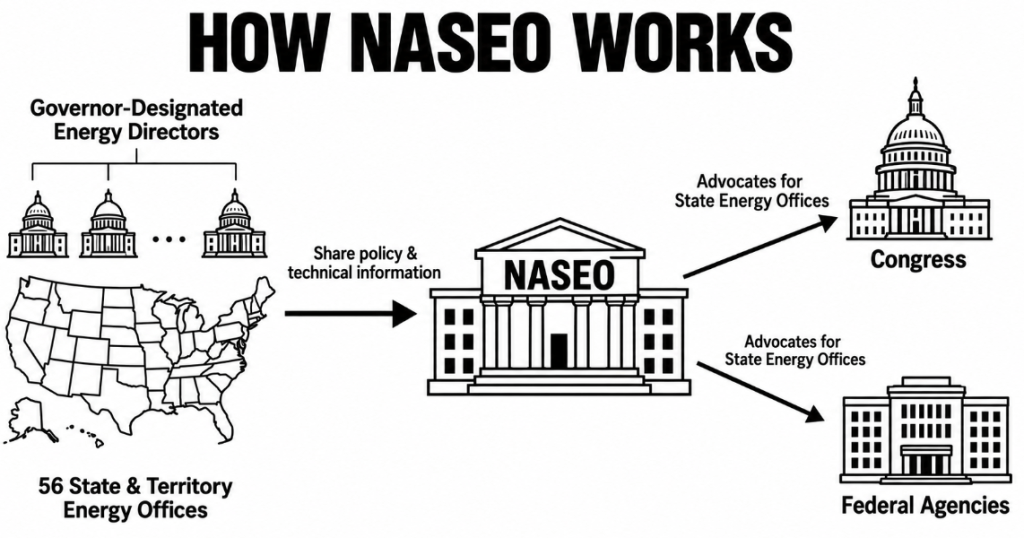
It is a national nonprofit organization representing the governor-designated energy directors and State Energy Offices of all 56 states and territories. It shares policy and technical information among states and advocates for State Energy Offices before Congress and federal agencies.
NASEO is not the Nuclear Regulatory Commission. It does not issue reactor licenses or replace legally required safety reviews. Its influence comes from bringing state energy offices, federal agencies and private industry together to shape policies, partnerships, financing strategies and development priorities.
That makes Wyoming’s leadership role important.
According to NASEO, the Advanced Nuclear First Mover Initiative is led by five state co-chairs: Indiana, Kentucky, New York, Tennessee and Wyoming.
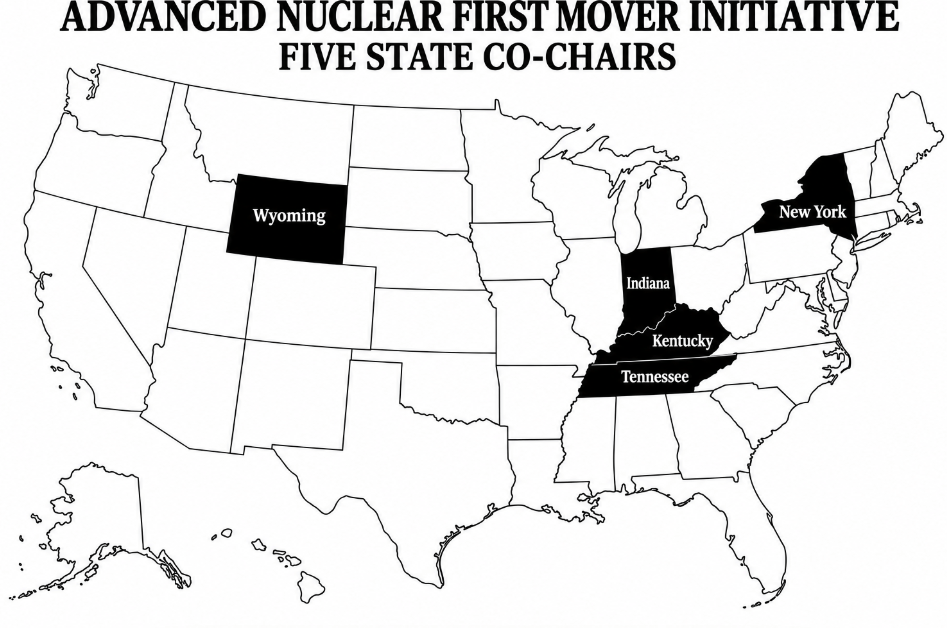
The other participating states are Louisiana, Maryland, Pennsylvania, Utah, Virginia and West Virginia.
What Is the Initiative Trying to Do?
The initiative is not simply studying whether advanced nuclear energy might be useful someday.
NASEO says participating states are working with private companies, the Department of Energy, the Nuclear Regulatory Commission and Congress to accelerate advanced nuclear projects.
Its stated goals include:
- Reducing financial and technological risks
- Promoting policies that encourage market adoption
- Improving the domestic nuclear supply chain
- Streamlining federal permitting
- Coordinating the purchase of advanced reactors
- Creating state-federal-private financing structures
- Building partnerships among governments, utilities, reactor companies, investors, manufacturers and major energy users
NASEO previously requested industry input on creating a coordinated nuclear “orderbook.” In plain language, that means finding ways for multiple potential customers or states to coordinate reactor orders, creating a stronger market signal for manufacturers and potentially lowering costs.
The organization openly describes this as a way to speed project development.
That deserves public attention.
Wyoming Was Already Quietly Laying the Groundwork
Wyoming’s role in this initiative did not appear out of thin air.
In 2023, the Wyoming Energy Authority published its Nuclear Energy Industrial Development Strategic Framework and Roadmap. The document envisioned Wyoming becoming a leader in the advanced nuclear economy.
It called for supporting additional reactor deployments, reducing financial and operational risks for utilities, building a nuclear supply chain and developing an industry permitting guide.
The roadmap also discussed supporting TerraPower, identifying additional potential Natrium sites, helping utilities locate reactor sites and identifying legislative or policy changes that could remove barriers.
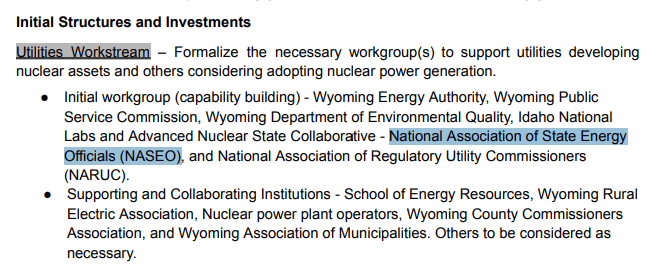
It named NASEO as part of the proposed structure for helping Wyoming agencies and utilities build the capacity needed to support nuclear development.
In other words, NASEO’s current First Mover Initiative fits directly into a strategy Wyoming had already placed on paper.
Then Came the BWXT Study
In September 2023, the Wyoming Energy Authority began what NASEO describes as a two-year contract with BWX Technologies, or BWXT, to evaluate the feasibility of deploying small reactors in Wyoming.
The executive summary went well beyond a general classroom-style study of nuclear technology.
BWXT envisioned developing a Wyoming-specific version of its BANR microreactor. The work included evaluating possible industrial users, identifying a potential lead site at a trona mine, examining sites for a broader fleet and studying regulatory, supply-chain and commercialization requirements.
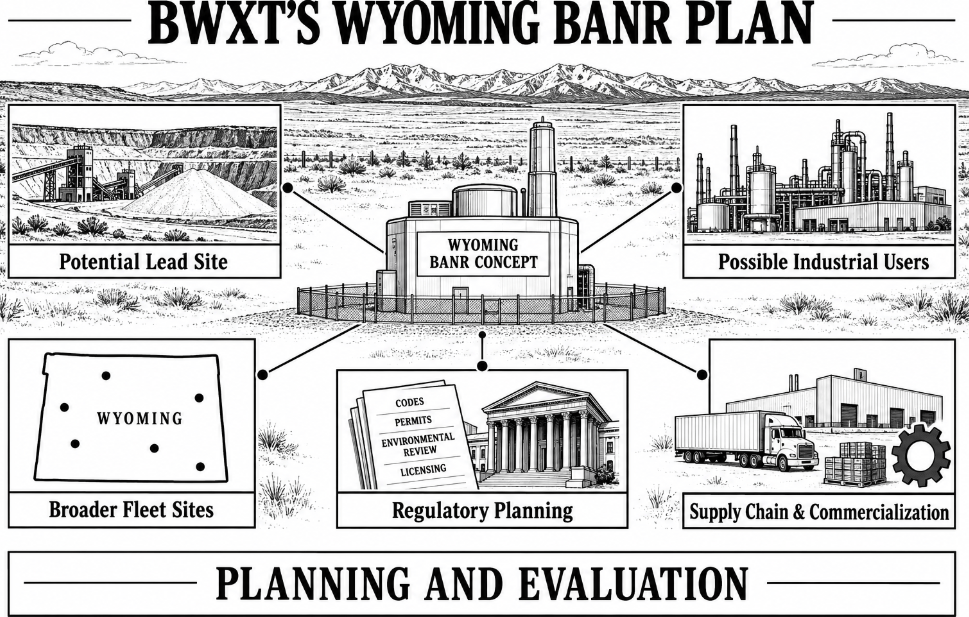
The stated goal was to give Wyoming and BWXT enough information to decide whether to deploy a lead microreactor, potentially followed by a fleet across the state and region.
The project sought $9,999,802 from the Governor’s Energy Matching Funds program. BWXT proposed matching that contribution with in-kind funding from its larger federal cost-shared reactor-development program.
Because this was described as a two-year contract beginning in 2023, it should not automatically be called an active contract in 2026 without updated documentation. What remains important is what the project was designed to accomplish and how closely it matched Wyoming’s broader nuclear roadmap.
The Strategy Expanded Beyond Wyoming
In April 2025, Governors Mark Gordon, Spencer Cox and Brad Little signed an agreement connecting Wyoming, Utah and Idaho through a regional energy partnership.
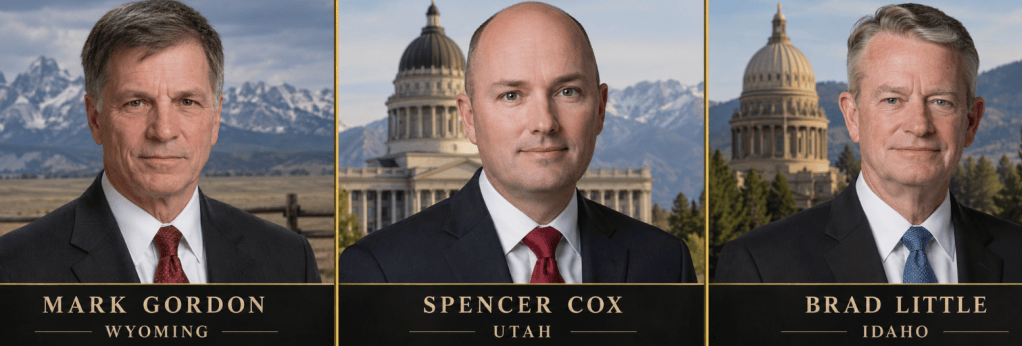
The three-state agreement was announced during Utah’s Built Here: Nuclear Energy Summit.
“The West will lead the next chapter of energy abundance and American prosperity,” Utah Governor Spencer Cox said. “Today, we brought together industry leaders, investors, and policymakers to chart the course for nuclear energy. Our new compact strengthens our shared commitment to aggressively pursue more affordable, reliable energy across state lines.”
Now Wyoming is also helping lead NASEO’s national First Mover Initiative.
This is no longer a collection of unrelated announcements. It is a coordinated state, regional and national development strategy.
Where Does the Public Fit?
NASEO says the participating states are developing “robust local stakeholder engagement and education activities” to support the safe and rapid implementation of advanced nuclear energy.
That sounds reassuring, but it leaves critical questions unanswered.
- Who represents Wyoming during First Mover Initiative meetings?
- Which nuclear companies, utilities, hyperscalers and investors are advising the participating states?
- What commitments has Wyoming discussed?
- Which financial risks could be assigned to private developers, federal taxpayers, Wyoming taxpayers or utility customers?
- Will communities be consulted while projects and policies are still changeable, or educated after the primary direction has already been chosen?
- Where can residents find meeting schedules, agendas, attendance lists, minutes and recommendations?
NASEO’s public webpage specifically invites interested private-sector organizations to contact the association. It promises local stakeholder engagement, but the page does not explain how ordinary Wyoming residents can participate in the initiative’s work.
That imbalance needs to be corrected.
This Is About Consent, Not Ignorance
None of this proves that a particular reactor or nuclear facility has received final approval. NASEO cannot issue that approval, and every project still faces its own licensing, permitting, financing and environmental requirements.
But it does prove something important.
Wyoming is not passively waiting for nuclear companies to submit proposals. State institutions have been building roadmaps, studying reactor deployment, offering matching funds, coordinating with neighboring states and helping lead a national initiative designed to reduce barriers and accelerate development.
That may be exactly what some Wyoming residents want.
Others may have serious concerns about cost, water, waste, transportation, emergency planning, long-term liability and the concentration of financial risk.
Both groups deserve to know what is being developed in their area.
If Wyoming wants to be called a nuclear first mover, then transparency cannot arrive last.
Were you aware that Wyoming was helping lead this national effort?
Wyoming, the NRC Is Rewriting the Nuclear Rulebook Right Now and America Needs YOUR Help!
The federal rules governing radiation exposure, nuclear transportation, reactor licensing, medical materials and public access are being rewritten. Wyoming residents have only days to weigh in. This is not where we can depend on someone else to carry the weight; everyone’s voice matters in this regard. If you need help, reach out to someone who…

Wyoming Is Betting Billions on Nuclear. Taxpayers Could Be Left Holding the Waste.
Wyoming is risking public money on enriched uranium, safety failures, and nuclear waste. Wyoming is being sold a nuclear future built on jobs, investment, and “advanced” technology. But behind the sales pitch is a much larger chain of taxpayer subsidies, radioactive materials, industrial hazards, and waste that could remain dangerous for generations. The numbers demand…
Human Error Is Part of Nuclear Risk. So Why Narrow the Review? NRC-2025-0478-0001 Commenting Closes Soon.
A fourth wall break into how I journeyed through commenting to the NRC, and how you can too. With three days left to go and doing the research, on August 18, I submitted a public comment to the U.S. Nuclear Regulatory Commission regarding Docket NRC-2025-0478, the NRC’s proposed changes to how it implements the National…
 Boomtown or Meltdown
Leave a comment