
Wyoming is risking public money on enriched uranium, safety failures, and nuclear waste.
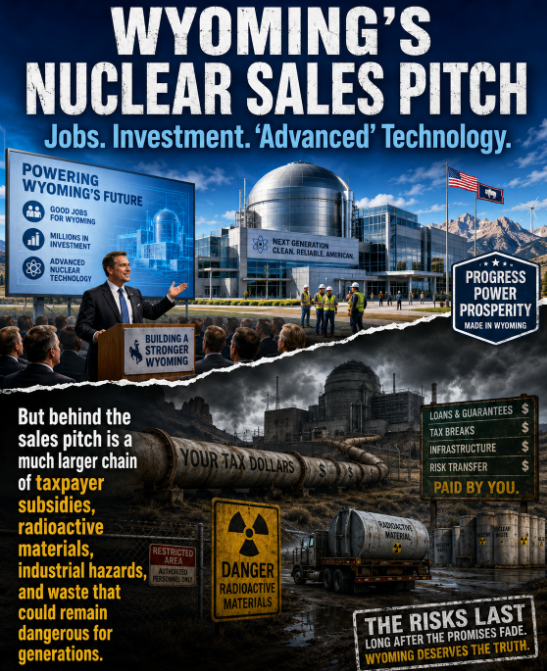
Wyoming is being sold a nuclear future built on jobs, investment, and “advanced” technology. But behind the sales pitch is a much larger chain of taxpayer subsidies, radioactive materials, industrial hazards, and waste that could remain dangerous for generations.
The numbers demand attention:
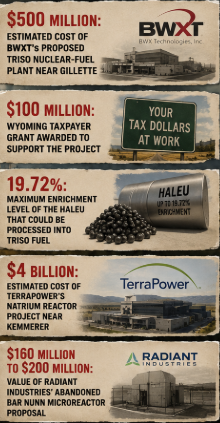
$500 million: Estimated cost of BWXT’s proposed TRISO nuclear-fuel plant near Gillette
$100 million: Wyoming taxpayer grant awarded to support the project
19.72%: Maximum enrichment level of the HALEU that could be processed into TRISO fuel
$4 billion: Estimated cost of TerraPower’s Natrium reactor project near Kemmerer
$160 million to $200 million: Value of Radiant Industries’ abandoned Bar Nunn microreactor proposal.
Radiant’s project collapsed in 2025 after residents learned that testing portable reactors would also mean managing irradiated reactor cores. Public resistance worked, and the company moved its plans to Tennessee.
Now Gillette is facing its own high-stakes decision.
BWXT presents its proposed facility as advanced manufacturing, but the company’s regulatory history raises serious questions. Federal records cited in the project research include:
An $87,500 NRC penalty following a roughly 20-liter radioactive liquid spill in 2023
A blocked safety line that forced material into part of the facility’s ventilation system
An NRC finding involving accumulated enriched uranium dust and increased criticality risk
A $2.6 million contract-fee reduction tied to serious radiation-protection failures at a Fluor-BWXT operation
More than $134,000 in cited OSHA penalties
This debate is also about local priorities.
Between 2020 and 2025, Gillette’s fixed monthly water charge reportedly increased 76%, while its wastewater charge rose 80%. At the same time, the Gurley Bridge, which carries an estimated 3 million to 4 million vehicles annually, could require $30 million to $40 million for replacement.
Wyoming residents should ask a simple question: Why are taxpayers being asked to place $100 million behind an experimental nuclear-fuel project while essential infrastructure and household costs remain unresolved?
This is not just a debate over whether nuclear technology can work. It is a debate over who assumes the financial risk, who controls the information, who manages the hazardous material, and who is left with the consequences if corporate promises fall short.
Wyoming has already seen one community say no. Gillette residents deserve the facts before another expensive experiment becomes a permanent obligation.
 Boomtown or Meltdown
Leave a comment