
A fourth wall break into how I journeyed through commenting to the NRC, and how you can too.
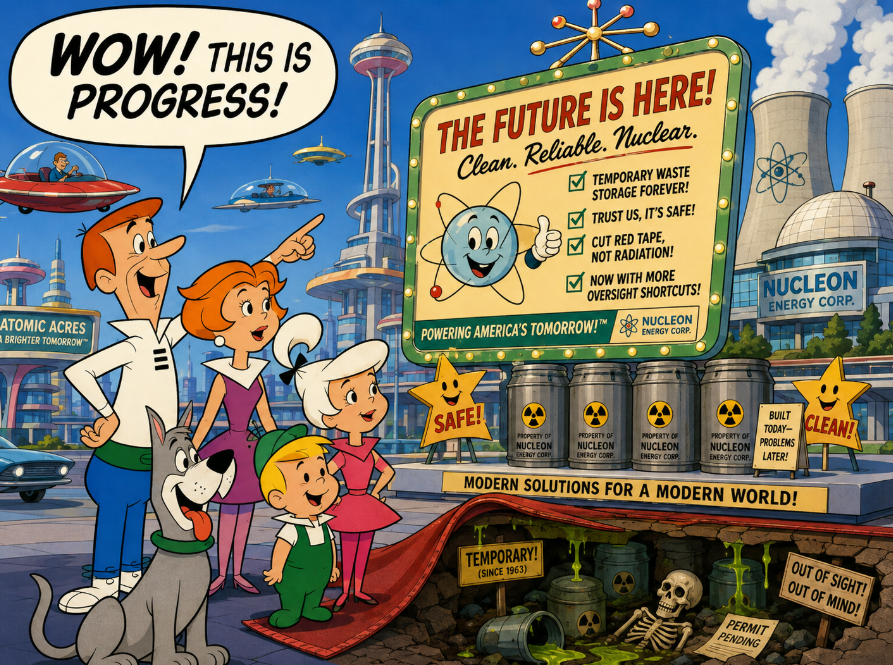
With three days left to go and doing the research, on August 18, I submitted a public comment to the U.S. Nuclear Regulatory Commission regarding Docket NRC-2025-0478, the NRC’s proposed changes to how it implements the National Environmental Policy Act, or NEPA.
I did not write the comment as an anti-nuclear manifesto.
I did not tell the NRC that every nuclear project is inherently unsafe.
I did not accuse the Commission of deliberately trying to hurt communities.
Instead, I asked a much simpler question:
What happens when regulatory streamlining begins removing some of the tools that help us identify risk before something goes wrong?
That became the foundation of my comment.
My Biggest Concern Was Human Error
One thing that bothers me about discussions surrounding nuclear regulation is how easily risk gets separated into neat little categories.
Radiological risk goes in one box.
Environmental impacts go in another.
Worker conditions go somewhere else.
Human performance becomes another specialized subject.
But an actual nuclear facility does not operate that way. It is one enormous system.
People operate machinery. People interpret alarms. People perform maintenance. People make decisions under pressure. Weather affects facilities. Infrastructure affects workers. Environmental conditions affect emergency response. Management decisions affect operators.
Sometimes a serious accident is not caused by one enormous failure. It is caused by several smaller failures lining up. That is why I focused heavily on human error and complex systems.
The proposed changes to 10 CFR Part 51 would alter how the NRC defines and evaluates environmental effects under NEPA. My concern is that narrowing environmental review too aggressively could cause regulators to examine individual pieces of a project without adequately considering how those pieces interact.
So rather than simply writing, “This is dangerous,” I asked the Commission a question:
Can we really separate a radiological hazard from the human and environmental conditions surrounding it?
That is the issue I want answered.
I Used the NRC’s Own Research
This was also intentional. Instead of building the argument entirely around outside environmental organizations or anti-nuclear sources, I referenced research produced for the NRC itself.
One was NUREG/CR-6753, which examines human performance and human error in operating events.
Another was NUREG-2114, which deals with human performance during severe accident conditions and the difficulty of decision-making when operators are dealing with complicated, rapidly changing emergencies.
That matters because my argument is not that human beings are incompetent. It is almost the opposite. Human beings are being asked to manage extremely complicated technology under circumstances where mistakes can have serious consequences. Good regulation should recognize that limitation.
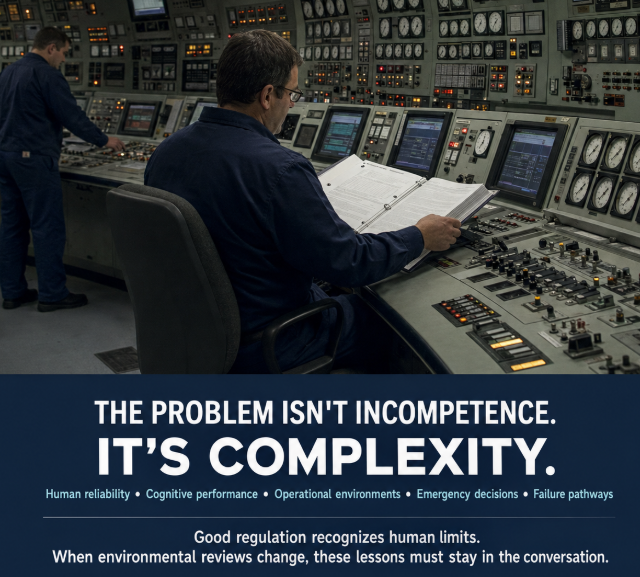
If the NRC’s own research has spent years studying human reliability, cognitive performance, operational environments, emergency decision-making and failure pathways, then I think those lessons should remain part of the conversation when environmental review requirements are changed.
Why I Focused on Environmental Impact Statements
Another major part of my comment concerned proposed revisions to Section 51.20 and the circumstances under which an Environmental Impact Statement, or EIS, would be required. This is important because an EIS is the heavyweight version of federal environmental review. It forces a much deeper examination of a major federal action.
My concern is not that every tiny regulatory decision needs thousands of pages of environmental paperwork.
It doesn’t.
My concern is what happens at the other end of the spectrum.
What about a new reactor?
What about major licensing decisions?
What about projects that could operate in a community for decades?
If major projects that previously received an EIS can instead move through a less comprehensive Environmental Assessment, the obvious question is whether something important could be missed.
And nuclear accidents are exactly the kind of events where “something we didn’t anticipate” matters. That is why I connected the EIS issue back to human performance. A facility can look safe on paper. Individual systems can meet their requirements.
But accidents frequently involve interactions between systems, people and circumstances that nobody expected to occur at exactly the same time. Comprehensive review is supposed to help expose some of those interactions before construction and operation.
I Also Questioned the Alternatives Analysis
One proposed change particularly caught my attention because it sounds procedural but could have enormous consequences. NEPA has traditionally required agencies to examine alternatives to a proposed action.
That concept is important. It asks more than:
Can we approve this project?
It also asks questions like:
Could it be built somewhere else?
Could it be designed differently?
Could environmental impacts be reduced?
Is there another reasonable way to accomplish the same objective?
My comment questioned proposals that could significantly narrow that analysis.
Because if regulators primarily compare:
Approve the project
versus
Do nothing
we lose something valuable.
The public should be able to see whether reasonable alternatives existed between those two extremes. Sometimes the best answer is not “yes” or “no.”
Sometimes it is:
Yes, but somewhere else.
Yes, but with another design.
Yes, but with additional protections.
That is exactly why alternatives analysis matters.
Why I Wrote the Comment Respectfully
The tone was deliberate too. There is plenty about nuclear policy that makes me angry. But anger was not the purpose of this comment.
A regulatory docket becomes part of an official administrative record. I wanted the substance of my concerns to be difficult to dismiss.
So instead of writing:
The NRC is gutting environmental protections.
I wrote:
How will these changes affect the NRC’s ability to identify risk?
Instead of declaring:
This will cause accidents.
I asked:
Could narrowing these reviews cause regulators to miss some of the conditions that contribute to accidents?
That difference matters. I am not pretending to know everything. Neither should anyone commenting on complicated nuclear regulation.
But members of the public do not have to possess nuclear engineering degrees before asking reasonable questions about decisions that could affect their communities. We are allowed to ask regulators to explain themselves.
In fact, that is part of the purpose of public comment.
Why I Mentioned Wyoming
I ended the comment by bringing the issue home. Wyoming is currently being asked to accept enormous changes to its energy landscape.
Nuclear projects, uranium development, advanced reactors, fuel-cycle facilities and federal energy policy are no longer abstract subjects happening somewhere else.
They are becoming local issues. And Wyoming residents have every right to say:
We support economic development, but we also expect serious oversight in regards to potentially dangerous industries such as nuclear.
Those positions are not contradictory. You can support innovation while demanding scrutiny. You can support energy development while protecting groundwater. You can support new technology while questioning whether regulations are being weakened too quickly.
And you can support nuclear energy while still insisting that nuclear regulators remain extremely cautious.
The Point Wasn’t to Stop Everything
This is probably the most important distinction. My comment was not asking the NRC to make nuclear development impossible. It was asking the NRC not to confuse speed with safety. There are absolutely bureaucratic processes that can be improved. There are outdated rules. There are redundant reviews.
Government agencies should periodically examine whether regulations still make sense. But nuclear regulation has an unusual characteristic:
When regulators remove a requirement because it seems unnecessary, we may not discover why that requirement mattered until something goes wrong.
That deserves caution. Especially when we are talking about facilities intended to operate for decades.
And That Is Why People Should Comment
You do not need to submit a 40-page technical analysis. You do not need to be a lawyer. You do not need to be a nuclear engineer.
You can read the proposal, identify something that concerns you, explain why it matters to your community and ask the agency to address it. That is what I tried to do.
My comment essentially asks the NRC:
Before you reduce environmental review requirements, show us that the things being removed are not also part of the safety system.
Because environmental review is not simply paperwork. Sometimes paperwork is the record showing that somebody stopped long enough to ask:
What are we missing?
And with nuclear technology, that may be one of the most important questions we can ask.
My full comment here:
August 18, 2026
U.S. Nuclear Regulatory Commission Washington, DC 20555-0001 Submitted via Regulations.gov
RE: Docket ID NRC-2025-0478 Comments on Proposed NEPA Rule
To the Commissioners and Staff of the Nuclear Regulatory Commission:
I am writing to respectfully express my concerns regarding the proposed revisions to 10 CFR Part 51 under Docket ID NRC-2025-0478. I understand that the agency is under pressure to streamline processes and meet the goals of recent executive orders. I also recognize the incredibly difficult job the Commission has in balancing regulatory efficiency with the heavy responsibility of keeping the public safe. However, I am hoping to ask a few questions about how these specific changes might inadvertently compromise the thoroughness we all rely on to prevent accidents.
My main concern is about how this proposed rule handles the reality of human error in complex systems. In the proposed changes to Section 51.4, the rule redefines the scope of environmental “effects” to strictly cover what falls under your substantive statutory authority, essentially separating radiological impacts from non-radiological ones. I humbly ask the Commission: is it truly possible to separate a radiological hazard from the human and environmental factors that surround it?
Nuclear plants are massive, highly complex industrial facilities run by human beings. When these complex systems experience a failure, it is rarely just a mechanical glitch. It is usually a cascading chain of events complicated by human decisions. If we artificially narrow our environmental reviews to exclude non-radiological factors, do we not risk ignoring the very real environmental and workplace stressors that lead to human mistakes?
I wanted to bring forward some of your own agency’s research to help frame my questions. The NRC report NUREG/CR-6753 clearly details how human error is a significant driver of risk in operating events. The data shows that human failures are deeply connected to their operational environments. If we stop looking at the full, holistic picture of a site, how can we be sure we are accurately assessing the conditions that might cause an operator to make a critical error?
To continue, I have deep concerns about the proposed revisions to Section 51.20, which would remove the list of agency actions that automatically require an Environmental Impact Statement (EIS). Under the new rule, major projects like new reactor licenses or subsequent license renewals might only require an Environmental Assessment (EA) or a Categorical Exclusion.
I ask the Commission to consider the findings in your report NUREG-2114, which explains how incredibly difficult it is for operators to make the right cognitive choices during chaotic and severe accidents. Unpredictable human actions during a high stress crisis can turn a manageable situation into an emergency. Given these well documented risks, does it not make sense to maintain the highest level of scrutiny? An EIS provides a deep, comprehensive analysis of a site. It brings in independent oversight and local community context that a fast tracked EA might miss. By removing the automatic requirement for an EIS on major Federal actions, are we perhaps moving too quickly and missing the holistic risk factors that your own experts have warned us about?
I also have questions regarding the plan to change the “purpose and need” requirements so that the agency only has to look at the “no action alternative” compared to the proposed action. One of the greatest strengths of the NEPA process has always been its ability to help communities find the safest and most optimal solutions by comparing different alternatives. If we restrict the scope to just the proposed agency action, how will the public know that safer, better located, or less impactful alternatives were thoroughly vetted? Does this change not limit our ability to make the most informed decisions possible for our communities?
Out here in Wyoming we deeply value our land, our water, and the safety of our neighbors. We want to support energy development, but we also want to trust that the regulatory framework protecting us is as robust as possible. When environmental reviews are sliced into smaller pieces and major projects are potentially exempted from comprehensive impact statements, it becomes harder for everyday citizens to feel confident that all the risks have been accounted for.
I appreciate the time and effort the staff puts into these rulemakings, and I know your ultimate goal is to protect public health and safety. I respectfully ask that you reconsider these specific changes. Please look at the research your own experts have done on human performance, and please consider whether streamlining these reviews might inadvertently remove the safety nets that protect us all from unforeseen errors.
Thank you for your time and for considering my comment.
Sincerely,
[Name]
Casper, Wyoming
Leaving in the dropbox downloaded copies of:
https://www.nrc.gov/docs/ML1601/ML16014A045.pdf
 Boomtown or Meltdown
Leave a comment