
A nationwide rewrite of radiation-protection rules could affect workers, families, uranium operations, fuel facilities, reactors, waste, transportation, and decommissioning.
ACTION DEADLINE: August 31, 2026, at 11:59 p.m. Eastern Time
DOCKET: NRC-2025-1140
SUBMIT A COMMENT: Go directly to Regulations.gov
Wyoming, I need you to pay attention to this one.
This is not somebody else’s fight. It is not an issue reserved for scientists in Washington, D.C., people living beside an existing reactor, or organizations with attorneys on staff. The federal government is rewriting the radiation-protection framework that applies to nuclear activities across the country, and it is proposing to remove one of the most basic principles in radiation safety: ALARA, or “as low as is reasonably achievable.”
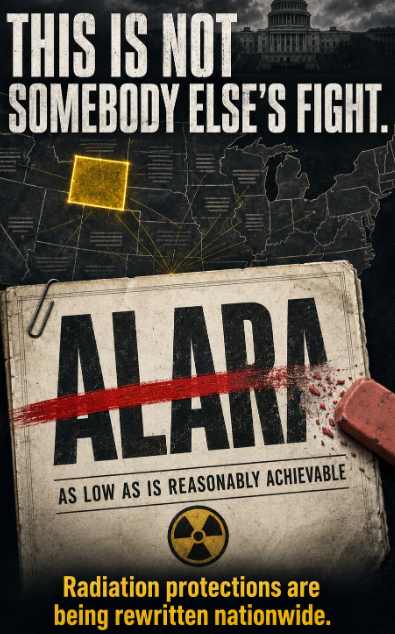
The current rule does not demand zero radiation. It does not require companies to pursue impossible reductions at any cost. ALARA means making every reasonable effort to keep radiation exposure well below legal dose limits while taking technology, economics, public-health benefits, and other practical considerations into account.
That balanced definition is written directly into 10 CFR § 20.100 and reading the whole report can sometimes be overwhelming.
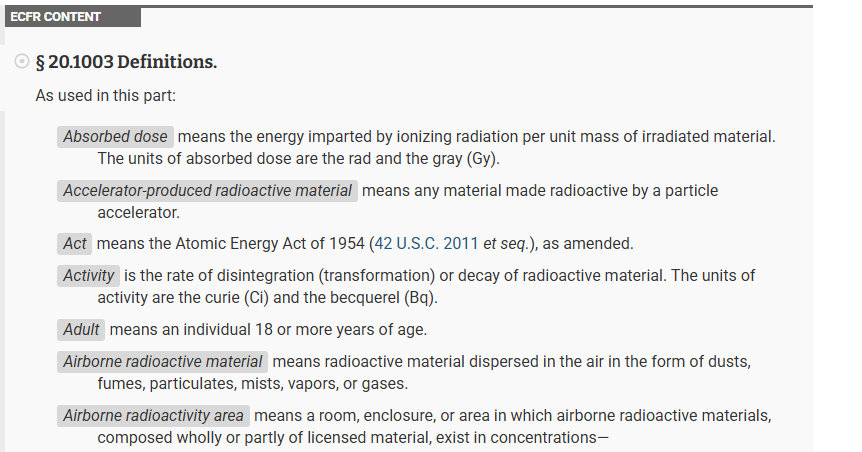
Screenshot from 10 CFR § 20.1003
In plain English, the legal limit is the ceiling. ALARA is the obligation to avoid pushing people toward that ceiling when reasonable precautions can keep their exposure lower.
But let us be honest: ALARA was already a weak compromise.
It never required radiation exposure to be kept as low as technically possible. Its definition allows the cost of improvements, the interests of nuclear development, and other economic and social considerations to influence what level of protection is considered “reasonable.”
Once again, that language is written directly into 10 CFR § 20.1003. In other words, money and industry convenience were already built into the safety calculation.
Now, instead of strengthening that inadequate standard, the Nuclear Regulatory Commission proposes eliminating ALARA and replacing it with a threshold-based “graded approach to dose management.”
Under that approach, stronger protections would be triggered only as expected or actual doses cross predetermined thresholds. The NRC is also stepping away from strict reliance on the Linear No-Threshold model, even while its own proposal admits there is insufficient evidence to refute LNT for stochastic health effects such as cancer.
This is not ALARA being replaced with stronger science. It is the NRC discarding an already compromised precautionary rule while weakening the low-dose risk assumptions beneath it.
Now the Nuclear Regulatory Commission wants to remove ALARA terminology from its regulations and guidance and replace it with a “graded approach to dose management.” The proposal was issued in response to Section 5(b) of Executive Order 14300, which directed the NRC to reconsider both ALARA and the Linear No-Threshold model used to assess low-dose radiation risk. The official proposal was published July 15, 2026, and comments are open only through August 31. You can read the full Federal Register proposed rule here.
That gives the public a narrow window to speak before these changes move forward.
What the NRC is actually proposing
This is not merely a vocabulary update.
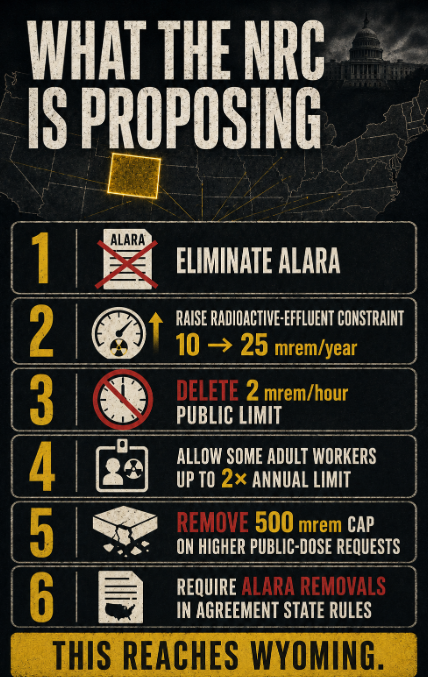
The proposed rule contains concrete changes to how radiation exposure would be managed:
Remove ALARA throughout NRC regulations and guidance. The NRC describes this as a “complete discontinuation” of ALARA terminology and would replace it with dose-management thresholds below the legal limits.
Increase the radioactive-effluent constraint from 10 to 25 mrem per year. This is the level tied to additional controls and reporting for airborne releases of radioactive material. The general public dose limit is not being raised across the board, but this specific emissions constraint would increase.
Delete the current short-term public limit of 2 mrem in any one hour. The NRC says an annual limit is sufficient and that licensees could voluntarily keep short-term limits in their own programs.
Create a new process allowing certain adult workers to exceed normal annual occupational dose limits. Under the proposed “planned occupational dose limit extension,” a licensee could authorize exposure up to twice the applicable annual limit when the worker has sufficient unused dose from the preceding five-year period. The proposal includes notice, recordkeeping, and other conditions, and it excludes declared pregnant workers and minors. Those conditions matter, but so does the creation of the pathway itself.
Remove the current 500-mrem ceiling on special requests for higher public exposure. The ordinary public dose limit would remain 100 mrem per year. However, the proposal would remove the existing 500-mrem upper boundary when a licensee asks the NRC for case-by-case permission to operate above that ordinary limit.
Push corresponding ALARA removals into Agreement State rules. The NRC states that Agreement States would be required to remove equivalent ALARA references in order to maintain a uniform national regulatory framework. Wyoming already operates a limited Agreement State program for uranium recovery, so the idea that this cannot reach us is simply wrong.
The NRC says these changes would provide clarity, flexibility, and relief from unnecessary regulatory burden while continuing to protect public health. That is the agency’s position, and people should read it for themselves.
But the public has every right to ask the obvious question: When a safety rule already requires only what is reasonable, why is the solution to erase it?
ALARA is not anti-nuclear. It is basic due diligence.
ALARA does not say every trace of radiation must be eliminated. It does not make dose limits meaningless. It recognizes that a permitted maximum is not automatically a target.
We understand this principle everywhere else. A factory may be legally allowed to emit a certain amount of pollution, but we still expect it to use reasonable controls. A workplace may operate machinery with unavoidable hazards, but we still require sensible steps to protect workers. A speed limit tells us the maximum lawful speed under ordinary conditions; it does not mean every driver should press the accelerator to that number in a blizzard.
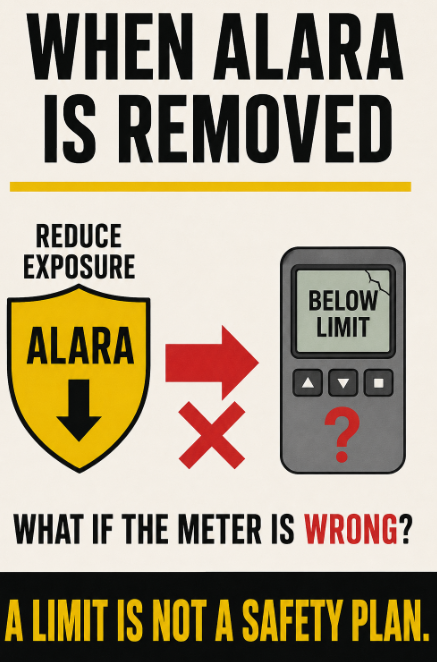
That is why removing ALARA matters. It shifts the center of gravity from continuously asking, “Can we reasonably reduce this exposure?” toward asking primarily, “Are we still below the limit?” Those are not the same safety culture.
Even the NRC’s own proposal acknowledges that there is insufficient evidence to refute the use of the Linear No-Threshold model for stochastic health effects such as cancer. The agency argues that uncertainty at very low doses has produced overly cautious implementation. But uncertainty cuts both ways. It is not proof that additional exposure is harmless.
The National Academies’ BEIR VII review supports a linear, no-threshold approach for estimating low-dose cancer risk. The Environmental Protection Agency also recognizes that children and fetuses are especially sensitive to radiation and that radiation-protection standards must account for differences related to age and sex.
That does not mean every tiny exposure will cause a detectable injury in an individual person. It means low-dose risk is difficult to measure, outcomes are probabilistic, people are not equally vulnerable, and the burden of uncertainty should not automatically be transferred from the regulated industry to workers and the public.
Why Wyoming must care
Wyoming is actively being asked to embrace more of the nuclear fuel cycle, if not the entire cycle in their newest race to the nuclear renaissance with nuclear lifestyle renovation educational camps.
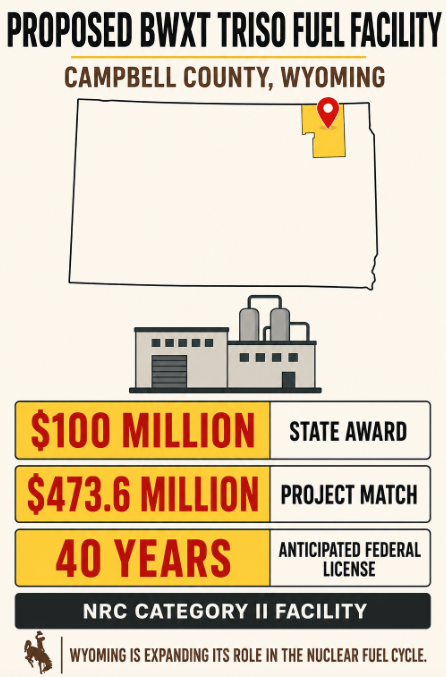
The state has awarded $100 million toward a proposed BWXT TRISO nuclear-fuel manufacturing facility in Campbell County. The project materials describe a planned NRC Category II facility, more than $473 million in matching funds, and an anticipated 40-year federal license.
Wyoming also has uranium-recovery operations and continuing state-level work to expand nuclear development. Those facts are documented in the Wyoming Energy Authority’s project summary.
So no, we do not get to wave this away as a coastal issue.
If Wyoming is going to host uranium recovery, nuclear-fuel manufacturing, advanced-reactor development, radioactive-material transportation, or any related activity, then the national radiation rules are part of our local reality. They affect the standards used to protect the people doing the work, the families living nearby, and the communities left with facilities after their operating years are over.
You can support nuclear energy and still oppose weaker radiation protections. In fact, anyone claiming this industry is safe should be able to support a requirement that licensees take every reasonable step to reduce unnecessary exposure.
That is not fear. That is not hysteria. That is due diligence.
Wyoming people know what happens when a boom is sold on jobs and promises while the long-term liabilities are treated like tomorrow’s problem. We have earned the right to ask what the rules require before a facility arrives, not after something goes wrong. What happens when the bust comes?
You do not have to be an expert to submit a useful comment
Federal agencies do not need another thousand identical slogans. They need a public record showing who is affected, what provisions people oppose, and why.
Regulations.gov explains that influential comments often provide sound reasoning, evidence, or a perspective the agency may not have considered.
A short, personal, specific comment can be more valuable than pages of copied language. Use the campaign’s Protect Better comment guide for additional background, but put the final message in your own words.
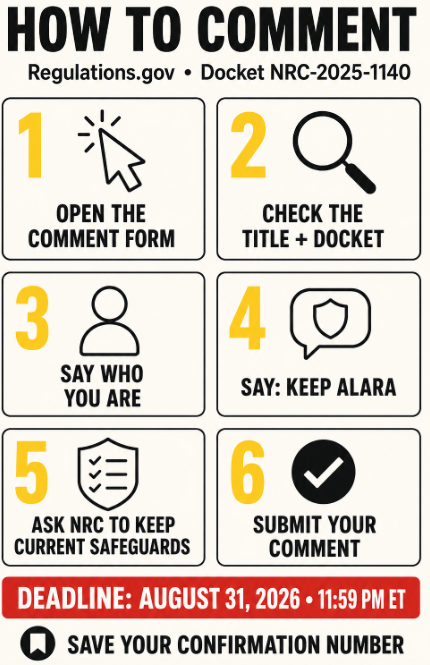
Take these six steps
Open the official Regulations.gov comment form.
Confirm that the page says “Reforming and Modernizing the Radiation Protection Framework” and shows Docket NRC-2025-1140.
Briefly identify yourself. You can say you are a Wyoming resident, parent, worker, landowner, health professional, student, rancher, or simply a concerned member of the public.
State clearly that you oppose eliminating ALARA and explain one or two reasons that matter to you.
Ask the NRC for specific action. For example, retain ALARA, retain the existing 10-mrem emissions constraint, retain the 2-mrem hourly public limit, and reject uncapped exceptions to ordinary public-dose limits.
Submit before 11:59 p.m. Eastern Time on August 31, 2026, then save your confirmation or tracking number.
The NRC warns that comments are public and displayed as received.
***Do not include an address, phone number, medical records, or other personal information you do not want published.
**** Anonymous comments are permitted.
A starting point for your own comment
Please personalize this. Add where you live and explain what makes this matter to you.
I am a resident of [city or county], Wyoming, and I oppose the proposed revisions in Docket NRC-2025-1140.
I urge the NRC to retain the ALARA principle in its regulations and guidance. The current definition already requires only reasonable exposure-reduction measures and expressly considers technology, economics, public-health benefits, and other practical factors. A legal dose limit should remain a ceiling, not become a target.
I am also concerned by the proposals to increase the radioactive-effluent constraint from 10 to 25 mrem per year, delete the 2-mrem-in-an-hour public limit, create a new process for occupational exposures above annual limits, and remove the current 500-mrem ceiling on case-by-case requests for higher public doses.
Wyoming is expanding uranium and nuclear-related development. These standards are therefore directly relevant to our workers, families, communities, and environment. Scientific uncertainty about low-dose radiation is not a sufficient reason to abandon a precautionary standard, especially when age and sex can affect vulnerability.
Please preserve ALARA and the Linear No-Threshold model as protective regulatory tools, retain the existing exposure and emissions safeguards, and strengthen transparency and public participation before adopting any final rule.
Ten minutes from Wyoming can help protect the entire country.
This is the part where people usually scroll past because the docket number looks complicated, the proposal is hundreds of pages long, and Washington feels far away.
Please do not scroll past this one. This is simple; and your voice matters. We can make a change. If not us, who will?
The people seeking these changes are counting on technical language and public exhaustion to keep ordinary Americans out of the record. We do not have to know every regulation by heart to recognize a dangerous policy direction. We only have to be willing to say that public-health protections should not be weakened for speed, convenience, or industry savings.
Wyoming has a voice in this. A parent in Casper has a voice. A miner in Campbell County has a voice. A ranch family worried about water has a voice. A person who supports nuclear power but expects rigorous regulation has a voice. A person who opposes nuclear expansion has a voice.
Use it.
Submit one thoughtful comment. Ask your spouse to submit one. Ask your adult children, coworkers, neighbors, elected officials, unions, health professionals, and local organizations to participate. Share the official link beyond Wyoming because this proposal is national.
The deadline is August 31, 2026. ALARA has protected workers and the public for decades. We should not let it disappear quietly.
SUBMIT YOUR OFFICIAL COMMENT HERE
LEARN MORE FROM THE PROTECT BETTER CAMPAIGN
ACTION DEADLINE: August 31, 2026, at 11:59 p.m. Eastern Time
DOCKET: NRC-2025-1140
SUBMIT A COMMENT: Go directly to Regulations.gov
As always, thank you for reading.
Primary sources and further reading
NRC proposed rule: Reforming and Modernizing the Radiation Protection Framework
Official Regulations.gov comment form for NRC-2025-1140-0001
Executive Order 14300, Ordering the Reform of the Nuclear Regulatory Commission
National Academies: Health Risks from Exposure to Low Levels of Ionizing Radiation, BEIR VII Phase 2
Regulations.gov: How You Can Effectively Participate in the Regulatory Process
Wyoming Energy Authority: BWXT TRISO Fuel Fabrication Facility project summary
 Boomtown or Meltdown
Leave a comment