
What BWXT’s federal filings reveal about how far BANR advanced before most Wyoming residents had ever heard its name
At a Glance:
Wyoming residents keep hearing two statements about BWXT’s nuclear plans. The first is that no BWXT Advanced Nuclear Reactor has been approved for construction in Wyoming.
That statement is true. The second is that the project is still only an idea, a study, or an early conversation that has not advanced very far. That description is far less complete.
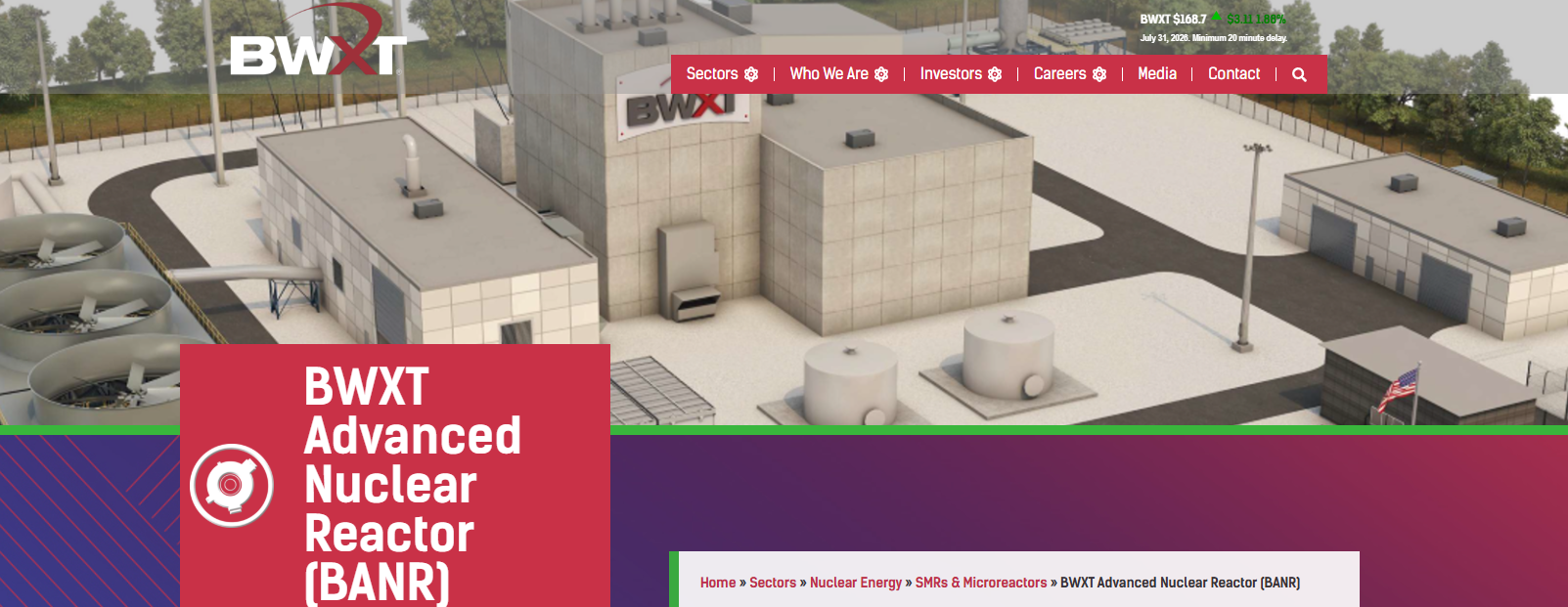
Years before most Wyoming families were debating whether they wanted a BWXT reactor, BWXT Advanced Technologies was already working through the federal regulatory system. The company met with the U.S. Nuclear Regulatory Commission, submitted a formal Regulatory Engagement Plan, filed the top-level quality-assurance program for its reactor development work, answered federal regulators’ questions, and obtained NRC acceptance of a revised version of that program.
No, that is not a permit to build a reactor. But it is not “nothing”.
It means BWXT is not standing at the starting line with a rough concept. The company has already secured federal acceptance of the internal system it says it will use to control important design, testing, procurement, documentation, and corrective-action work for BANR.
The reactor is not approved. The rulebook governing significant parts of its early development is. That is the distinction Wyomingites deserve to understand.
This Was More Than a Handshake and Less Than a Construction Permit
On November 30, 2022, BWXT submitted BANR-QAPD-001, Revision 000, to the NRC. QAPD stands for Quality Assurance Program Description.
The title sounds like paperwork only an engineer or federal attorney would care about. In reality, quality assurance is the system that determines how nuclear work is supposed to be planned, performed, checked, recorded, and corrected.
Think about everything that must happen before anyone pours concrete for a nuclear facility. Engineers must make calculations. Safety requirements must be translated into designs. Fuel must be tested. Equipment must be calibrated. Suppliers must be selected. Documents must be controlled. Mistakes must be identified and corrected. Someone must decide whether work is acceptable and whether it is safe to continue.

The QAPD establishes the top-level rules for those activities.
BWXT’s filing did not ask the NRC to approve a Wyoming location. It did not authorize the company to manufacture a commercial BANR reactor, load nuclear fuel, begin construction, or operate a power plant.
It did something earlier and more administrative: it asked federal regulators to review the management system BWXT intended to use for covered reactor-development work.
The NRC did not simply stamp the first version and walk away. Regulators reviewed the report, requested additional information, evaluated BWXT’s responses, and issued a final safety evaluation in February 2024. BWXT then transmitted BANR-QAPD-001-A, the NRC-accepted version, in April 2024.
So the honest description is not “BWXT already has permission to build.” It does not. The honest description is also not “nothing has happened yet.” A meaningful federal review has already happened, and part of BANR’s administrative foundation has already been accepted.
Wyoming Is Being Shown Individual Puzzle Pieces
The public conversation often treats every BWXT development as a separate event. One document is described as a study. Another is called a grant. A meeting is characterized as informational. A partnership is framed as workforce development. A supply-chain agreement is presented as economic development. A regulatory filing is dismissed as preliminary paperwork.
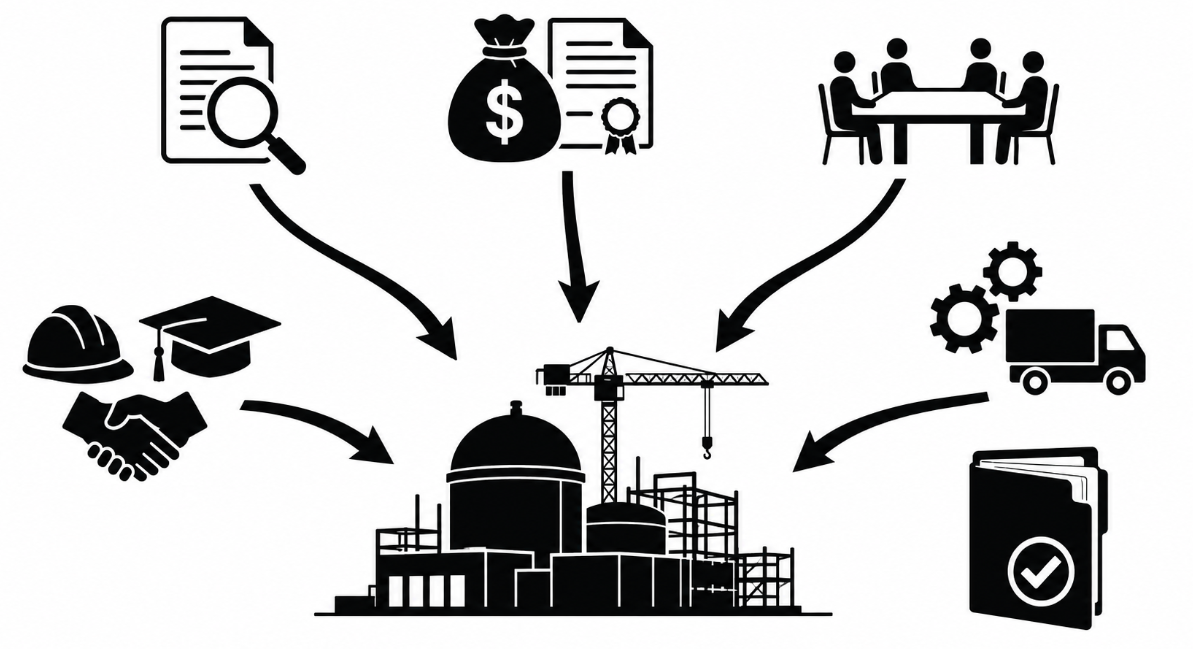
Viewed one at a time, each step can sound small. Viewed together, the pieces show a company positioning BANR for design maturation, testing, manufacturing, licensing, supply-chain development, and potential deployment.
Wyoming has already awarded BWXT Advanced Technologies $9,999,802 in state matching funds for Wyoming-specific BANR work. That project has included conceptual design, regulatory planning, market analysis, supply-chain evaluation, and development of a possible lead unit that could support a broader fleet model.
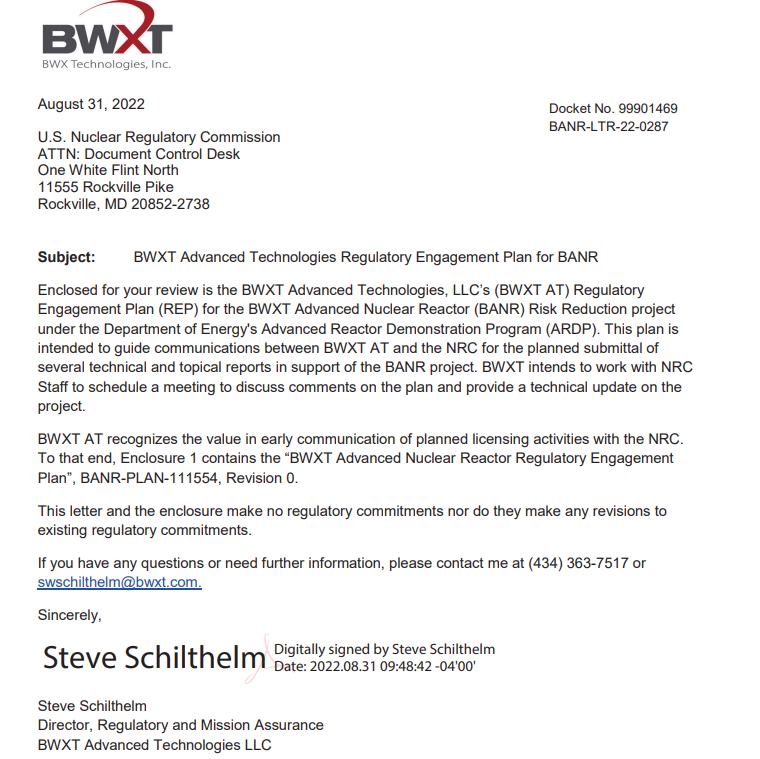
Screenshot of page 1 for ML22243A112
Separately, BWXT has proposed a major TRISO nuclear-fuel manufacturing facility in Campbell County with a different public-funding request and a separate federal licensing pathway. The reactor project and the proposed fuel facility should not be confused as one permit or one project. They are, however, connected parts of BWXT’s larger nuclear commercialization strategy.
That matters because Wyomingites are not being asked to evaluate a single isolated building. They are being asked to evaluate a developing nuclear footprint that could include fuel manufacturing, component production, workforce training, transportation, industrial customers, and eventual reactor deployment.
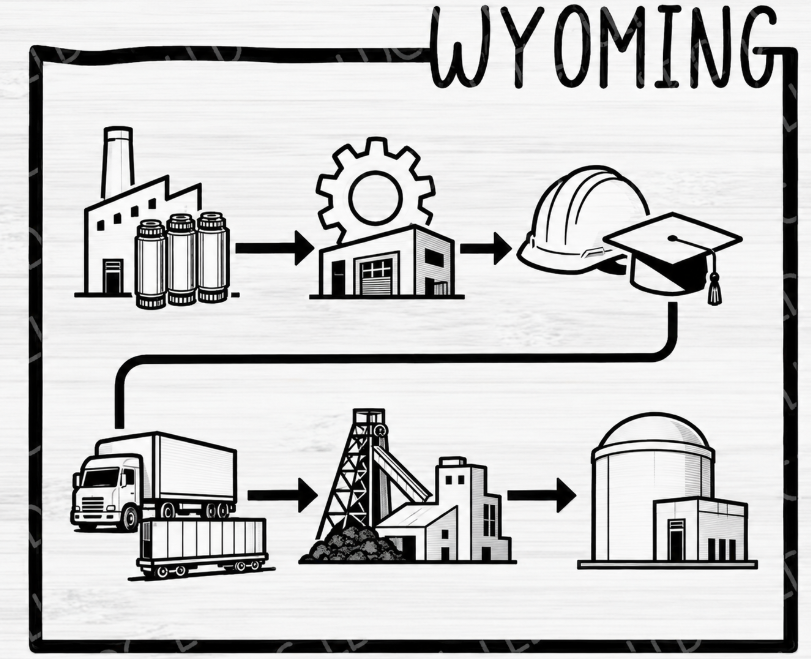
By the time every piece has its own contract, partner, funding stream, trained workforce, and political constituency, officials may still say no final reactor approval has been issued. Technically, they may be correct. Practically, the cost of changing direction may be much higher. That is how momentum works.
The First Version Covered What BWXT Was Doing Then, Not Everything It Might Do Later
BWXT’s original quality-assurance filing was limited to early technology-development and design work. Several controls associated with physical manufacturing, handling, storage, shipping, and operating status were marked as not applicable at that time.
That wording does not mean BWXT received a permanent exemption from those safety requirements. It means the company said it was not yet performing the activities that would make those sections applicable under the program’s stated scope.
This is an important difference.
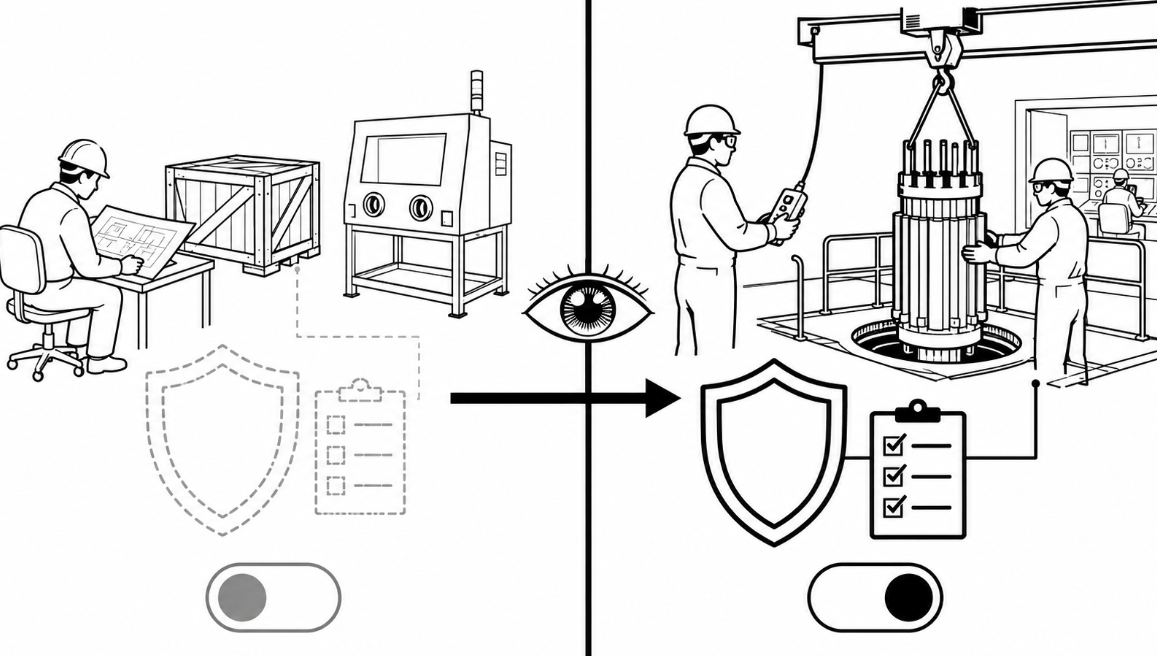
The company was not saying, “We never have to control these activities.” It was saying, “These controls do not apply to what we are doing right now.”
The public should therefore watch for the moment “not applicable” becomes “applicable.”
**** If BANR work moves further into physical fabrication, component handling, shipping, inspection, testing, or manufacturing, Wyoming officials and the public should demand the updated quality documents showing which controls have been activated, revised, or replaced. ****
The question is not merely whether BWXT wrote an acceptable policy in 2022. The question is whether the quality program is keeping pace with what BWXT is actually doing in 2026 and what it proposes to do next.
When Quality and Schedule Collide, Who Has the Final Word?
BWXT’s quality program gives quality-assurance personnel authority to identify unacceptable conditions and stop work when safety or quality is jeopardized. That authority is essential. A quality department cannot protect the public if it must ask the production schedule for permission to speak.
But the program’s escalation structure deserves close attention.
If the Director of Quality Assurance and the BWXT organization cannot resolve a quality dispute, the matter can be elevated through management, with the company president identified as the final point of disposition.
That does not prove that BWXT’s president can legally erase a safety violation, conceal a reportable defect, or simply order dangerous work to resume. Federal requirements, internal procedures, NRC inspection authority, and potential enforcement still apply.
The concern is the conflict built into the structure.
The company president is responsible for more than safety. The president is also responsible for budgets, staffing, customer expectations, business relationships, and project progress. When an unresolved quality dispute reaches the same executive responsible for delivering the project, Wyomingites have every right to ask how independence is protected in practice.
Who documents the disagreement?
Who decides whether stopped work can resume?
Can the quality director appeal outside the BANR business chain?
Are dissenting technical opinions preserved in the record?
Has anyone ever used the stop-work authority on BANR-related work?
Were employees supported when they raised concerns, or did they learn that raising concerns could threaten their position? A flowchart can promise independence. Only records can show whether that independence is real.
The Public Should Follow the Mistakes, Not Just the Promises
Every complex engineering program finds problems. The existence of a mistake does not automatically prove a company is reckless. What matters is whether the organization finds the problem early, tells the truth about it, understands why it happened, corrects it, and prevents it from happening again.
BWXT’s QAPD uses the regulatory term “condition adverse to quality” for problems that can affect quality. Those conditions are supposed to be identified and corrected. When a condition is classified as significant, the program requires a deeper cause evaluation and action to prevent recurrence.
That makes classification one of the most important pressure points in the entire system.
If management treats a recurring problem as a series of isolated minor events, it may repeatedly fix the symptom without addressing the underlying failure. A training weakness, poor procedure, supplier problem, design-control failure, or unhealthy safety culture can hide behind a stack of individually closed reports.

The public cannot judge the system by reading the QAPD alone. The QAPD tells us how the process is supposed to work. It does not tell us how BWXT classified each real problem, how many corrective actions became overdue, whether auditors found repeat issues, or whether NRC inspectors disagreed with the company’s conclusions.
Those implementation records are where accountability lives.
Wyoming leaders should be requesting data, not accepting slogans:
How many conditions adverse to quality have been documented in BANR-related work?
How many were classified as significant?
How many involved design control, testing, fuel, software, calibration, or suppliers?
How many corrective actions were overdue?
How many problems recurred after BWXT said they were corrected?
Did NRC staff, independent auditors, customers, or national laboratories identify issues BWXT failed to recognize first?
What trends did BWXT identify across supposedly minor events?
“Safety is our priority” is a public-relations statement. Corrective-action records are evidence.
Primary Documents
U.S. Nuclear Regulatory Commission, BWXT Advanced Nuclear Reactor Quality Assurance Program Description, BANR-QAPD-001, Revision 000, submitted November 30, 2022.
U.S. Nuclear Regulatory Commission, BWXT Advanced Technologies Regulatory Engagement Plan, submitted August 31, 2022.
U.S. Nuclear Regulatory Commission, BANR Licensing Activities NRC Kick-Off Meeting, October 20, 2022.
U.S. Nuclear Regulatory Commission, Final Safety Evaluation for Topical Report BANR-QAPD-001, February 2024.
U.S. Nuclear Regulatory Commission, BANR-QAPD-001-A Accepted Version Transmittal, April 2024.
 Boomtown or Meltdown
Leave a comment