
Supporters of nuclear development frequently point to France as proof that a country can build a large nuclear industry successfully. What is often left out is how that program was created.
At a Glance:
France launched the Messmer Plan on March 6, 1974, without a national referendum or full parliamentary debate.
The plan called for thirteen reactors immediately, followed by six or seven additional reactors each year.
Swiss voters rejected mandatory nuclear shutdown dates in 2016, proving direct democracy does not automatically produce anti-nuclear outcomes.
In 2017, Swiss voters approved an energy law prohibiting construction of new nuclear power plants.
Wyoming committed $100 million in public funding to the BWXT project without giving residents a statewide vote on the investment.
France did not ask its citizens to approve the rapid nuclear expansion launched under Prime Minister Pierre Messmer.
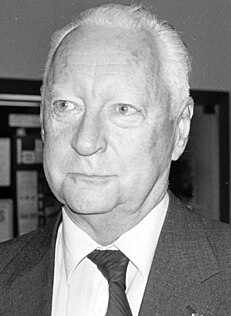
Pierre Messmer in 1988 image via Wikicomons
Following the 1973 oil crisis, the French government announced the Messmer Plan on March 6, 1974. It called for the immediate construction of thirteen reactors and a continued pace of six or seven reactors per year. The program was driven by the national executive, EDF and France’s technical establishment. It was not approved through a national referendum, and a later French parliamentary report observed that the broader nuclear program had never been fully debated by Parliament.
Read more what happened here: French Senate history of the Messmer Plan, French National Assembly report
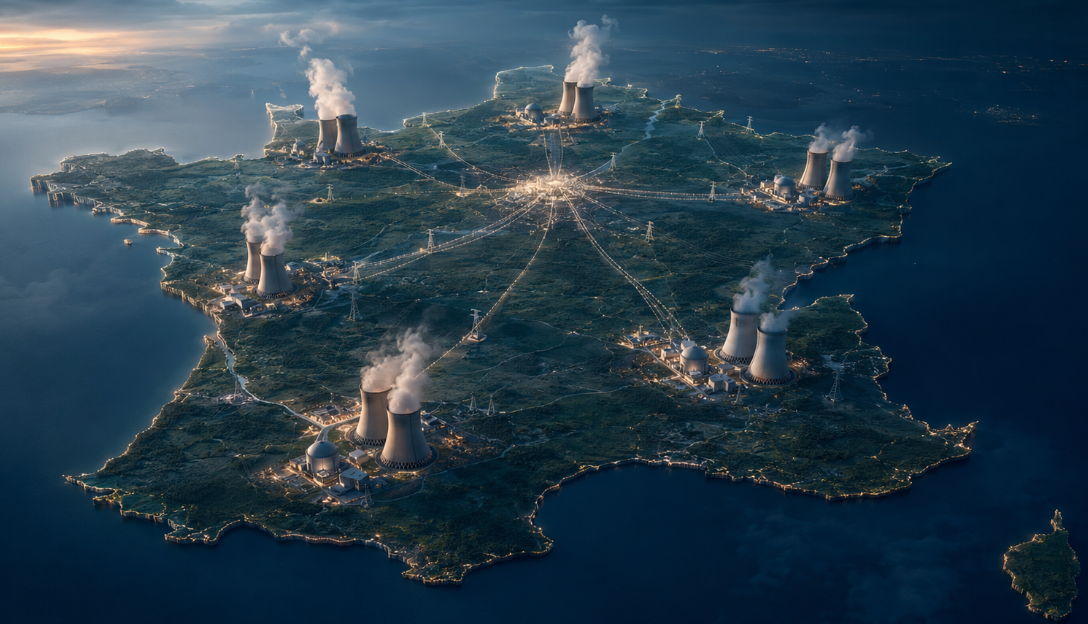
AI artistic interpretation of reactors in France
France represents a centralized, state-led model. Government leaders identified nuclear power as a strategic national necessity and moved quickly. That structure enabled France to construct dozens of reactors in a relatively short period, but speed came at the expense of meaningful public consent before the country was committed to the program.
Switzerland offers a different model.
Swiss nuclear policy still involves federal regulators, technical experts, Parliament and the Federal Council. It is not true that every nuclear decision requires approval from every affected community. However, Swiss citizens possess a far more direct role through the country’s referendum system.
In 2016, Swiss voters considered an initiative that would have imposed fixed shutdown dates on existing nuclear plants. They rejected it. In 2017, voters approved the revised Energy Act, which prohibited construction of new nuclear power plants as part of the country’s Energy Strategy 2050. The important point is not that Swiss voters always oppose nuclear power. They do not. The important point is that they are repeatedly given a formal opportunity to decide major questions. Swiss 2016 nuclear vote, Swiss 2017 Energy Act vote
Switzerland’s proposed geological repository follows a similar structure. The application and public responses are made available, interested parties may submit objections, cantons participate in the process, and the general license must receive approval from both the Federal Council and Parliament. Parliament’s decision is then subject to an optional national referendum, meaning citizens can force a nationwide vote if the legal requirements are met.
Read more here: Swiss Federal Office of Energy licensing process
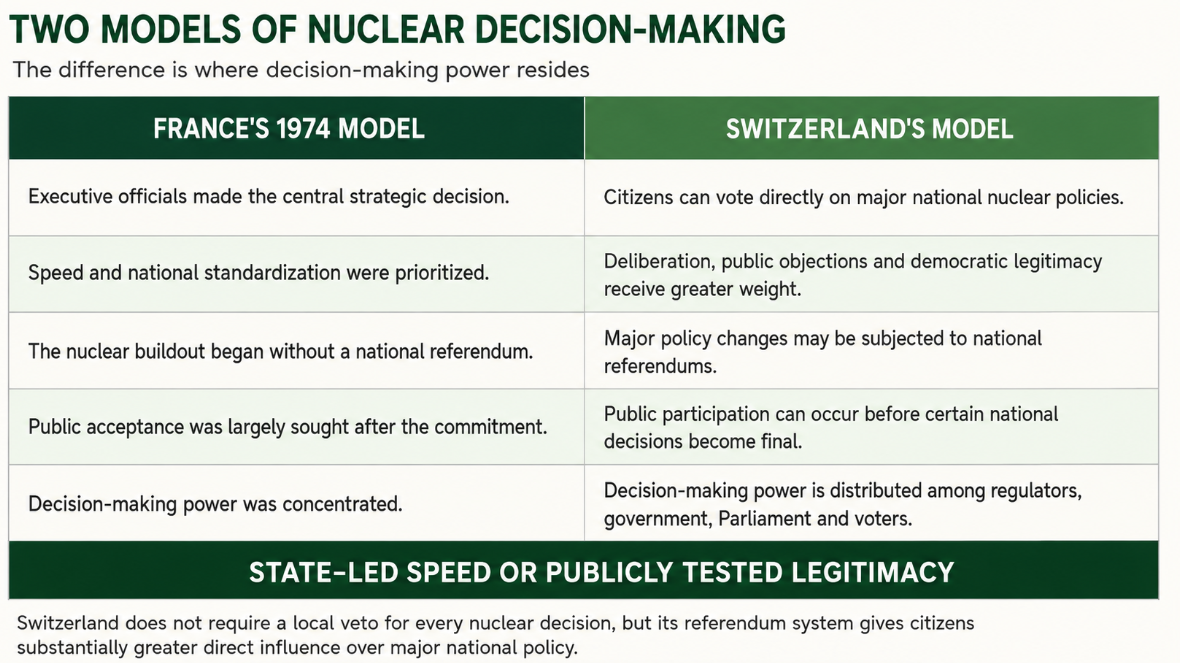
Neither system eliminates technical regulation. Neither gives every individual citizen an absolute veto. The difference is whether public consent is treated primarily as something to obtain after the government has committed itself or as something capable of shaping the commitment itself.
The Choice Wyoming Must Make
Wyoming is not France in 1974.
BWXT is not proposing an ordinary private development financed entirely with private money. The company is seeking to establish a nuclear fuel manufacturing facility involving enriched uranium, federal licensing, state assistance, local infrastructure, emergency planning and $100 million in Wyoming public funding.
Wyoming citizens were not asked to vote on that award. They were not given Switzerland’s referendum model. Yet they are now being told, in effect, that the important recruitment work had to occur privately and that the public can participate later through licensing and permitting.
That is much closer to the French model: officials make the strategic commitment first, build financial and political momentum, and invite the public into the process after reversing course has become increasingly difficult.
This is extremely unethical for our American rights and standards.
Final Thoughts
The issue is not whether France’s reactors produced electricity or whether Switzerland’s process takes longer. The issue is where Wyoming believes legitimate governing authority should reside when public money, nuclear material and multigenerational consequences intersect.
Economic development does not require government secrecy. Technical expertise does not replace democratic legitimacy. Regulatory hearings do not erase decisions already negotiated behind closed doors. A public-comment period is not the same thing as public consent.
Wyoming does not have to copy France or Switzerland. It can establish its own standard:
Disclose major commitments before they become politically irreversible, release the binding documents, identify the public costs, require independent technical review, allow meaningful participation before final decisions, and make officials defend their votes on the record.
Sources Cited
Assemblée Nationale (France). 1998. Rapport sur l’aval du cycle nucléaire (Rapport d’information No. 1359). Commission des Affaires Économiques, de l’Environnement et du Territoire. https://www.assemblee-nationale.fr/11/rap-off/r1359-03.asp
Assemblée Nationale (France). 2023. Rapport d’information fait au nom de la commission d’enquête visant à établir les raisons de la perte d’indépendance et d’autonomie énergétique de la France (Rapport No. 917). https://www.assemblee-nationale.fr/dyn/16/rapports/cion-eco/l16b0917_rapport-fond.pdf
Cowboy State Daily. 2025. “Wyoming Awards $100 Million To BWXT For Nuclear Fuel Plant In Gillette.” Published December 19, 2025. https://cowboystatedaily.com/2025/12/19/wyoming-awards-100-million-to-bwxt-for-nuclear-fuel-plant-in-gillette/
Sénat (France). 2024. Rapport d’information sur la situation de la filière nucléaire française et la mise en œuvre du Plan Messmer. https://www.senat.fr/rap/r25-166/r25-1661.pdf
Swiss Federal Office of Energy (SFOE). 2017. Energy Strategy 2050 and the Total Revision of the Federal Energy Act. Federal Department of the Environment, Transport, Energy and Communications (DETEC). https://www.bfe.admin.ch/bfe/en/home/policy/energy-strategy-2050.html/
Swiss Federal Office of Energy (SFOE). 2023. General Licence Procedure for Deep Geological Repositories in Switzerland. Nuclear Energy Division. https://www.bfe.admin.ch/bfe/en/home/supply/nuclear-energy/radioactive-waste/deep-geological-repositories/licence-procedure.html
Swiss Federal Council. 2016. Popular Initiative “For the Orderly Withdrawal from Atomic Energy” (Nuclear Phase-Out Initiative). Federal Chancellery (BK). https://www.admin.ch/gov/en/start/documentation/votes/20161127.html
Wyoming Energy Authority (WEA). 2025. “Governor Approves Large Project Energy Matching Funds to Move President Trump’s Energy Dominance Agenda Forward.” Office of Governor Mark Gordon. https://wyoenergy.org/governor-approves-large-project-energy-matching-funds-to-move-president-trumps-energy-dominance-agenda-forward/
 Boomtown or Meltdown
Leave a comment