
When a company proposes a half-billion-dollar nuclear fuel facility, the public is not “interfering” with a private business deal by asking questions.
At a Glance:
$573.6 million project: Includes $100 million in Wyoming funding and a proposed 40-year NRC license.
The deal is not the permit: Political support and signed agreements are not final authorization.
Federal licensing is required: BWXT must satisfy NRC safety, security and environmental requirements.
Evidence must enter the record: Deadlines matter, including a possible 30-day judicial-review window.
Citizens have leverage: Records, hearings, evidence, legal challenges and elections can influence the outcome.
A nuclear energy business is not a barbershop changing owners or a rancher buying another tractor. BWXT’s proposed Campbell County facility would manufacture TRISO nuclear fuel containing enriched uranium, operate under a federal nuclear license, depend on state and local cooperation, and receive $100 million from Wyoming’s Large Project Energy Matching Fund. The state describes the project as a $573.6 million investment expected to operate under a 40-year Nuclear Regulatory Commission license. Wyoming Energy Authority project summary
That makes the public a stakeholder.
It does not mean citizens automatically possess a veto. It means the project must pass through government-controlled gates, and the public has specific places to demand records, present evidence, challenge assumptions, seek enforceable conditions, and, when legally justified, contest an approval.
The Deal Is Not the Permit
One of the most important things Wyoming residents must understand is that a corporate announcement, signed letter, funding commitment, land agreement, or political endorsement is not the same thing as final legal authorization.
Politicians can support a project (albeit, should be openly). Economic-development officials can recruit it. A company can negotiate for land and announce construction plans. None of that eliminates the need for applicable federal, state, and local approvals.
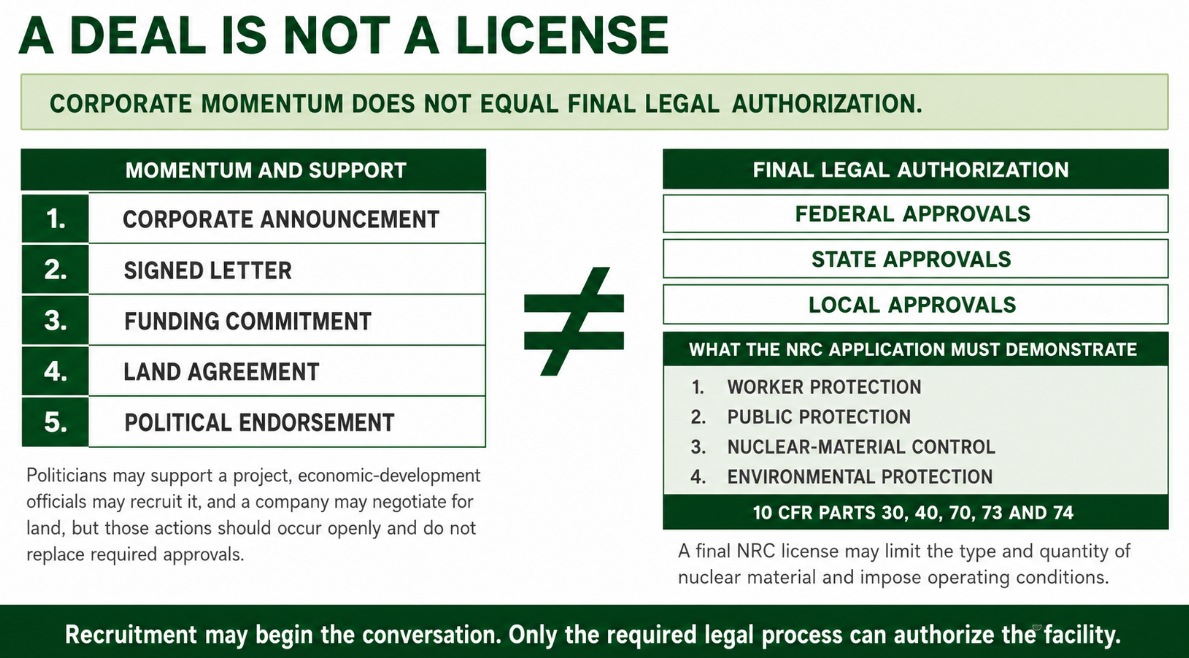
A nuclear fuel fabrication facility must apply to the NRC and demonstrate that it can protect workers, the public, nuclear material, and the environment under federal regulations, including 10 CFR Parts 30, 40, 70, 73, and 74. A final license may contain limits on the type and quantity of material the facility can possess and other operating conditions. NRC fuel-cycle licensing overview
Wyoming’s industrial-siting process may separately examine environmental, social, economic, health, safety, decommissioning, and reclamation issues if the project falls within the statute’s jurisdiction.
The public’s job is not simply to shout “no” after every agreement has been signed. It is to identify each government decision before it becomes final and build a record at the proper level.
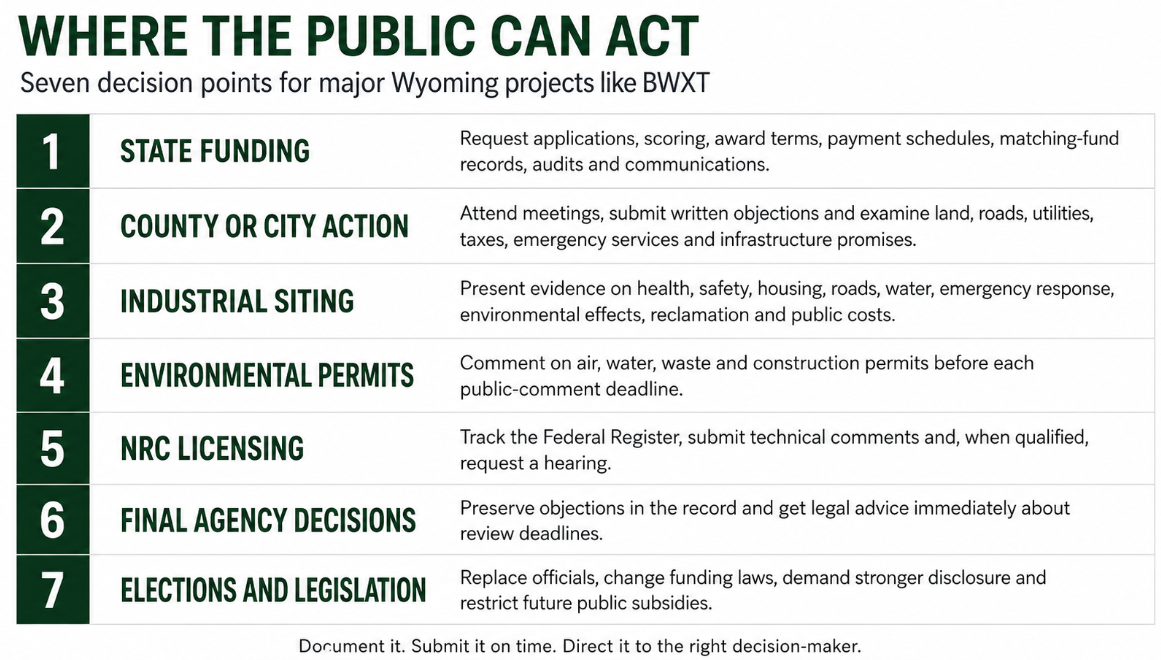
Where the Public Has Leverage
These are not interchangeable. Although activism on social media is great, five hundred Facebook comments do not replace one properly supported filing submitted to the correct agency before its deadline.
What “Showing Cause” Actually Means
People often say officials should make BWXT “show cause” why the project should proceed. That phrase has a legal meaning only in certain proceedings, but the underlying idea is sound: make the applicant prove that it satisfies the standards governing the particular decision.
A serious challenge generally needs four things:
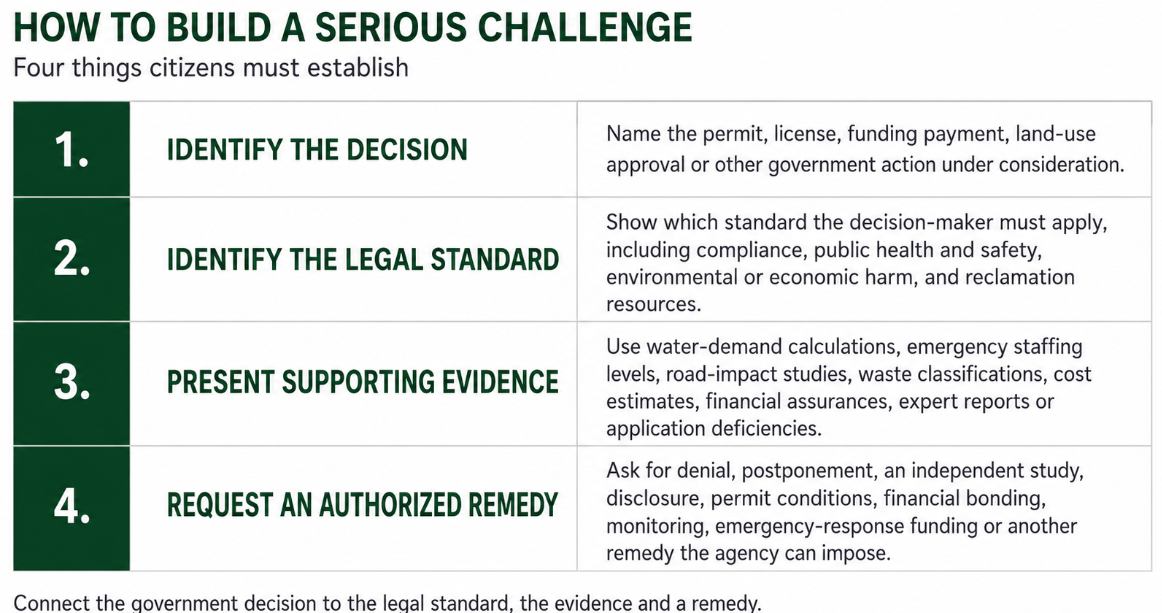
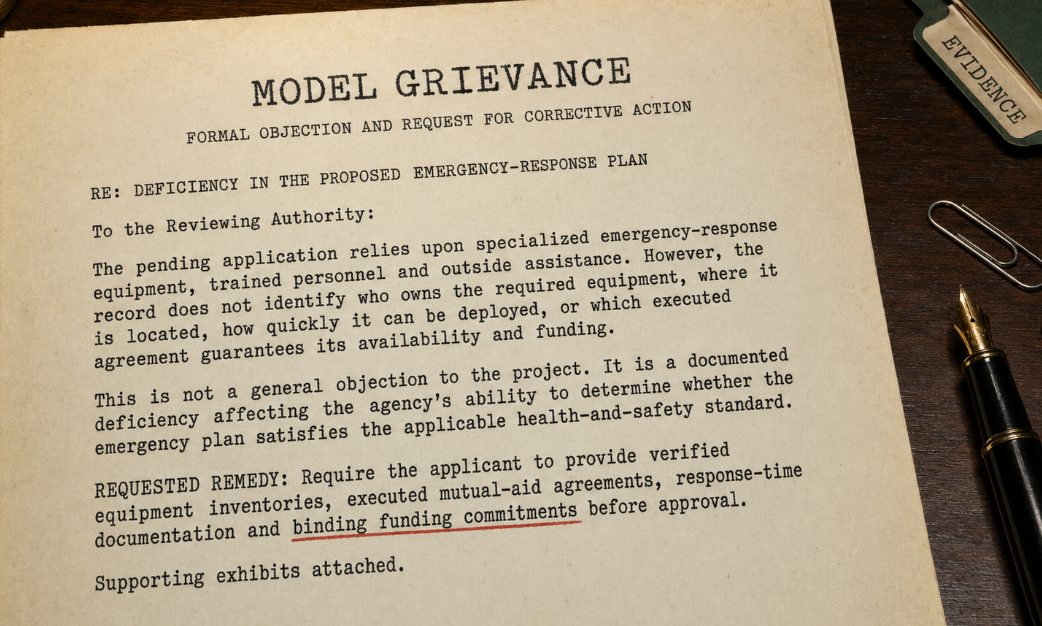
“BWXT is dangerous” is an opinion. “The application’s emergency plan assumes response equipment that Campbell County does not possess, and no binding funding agreement explains who will provide it” is a reviewable issue when dealing with people above certain levels of government and process.
The Industrial-Siting Hearing Matters
For projects covered by Wyoming’s Industrial Development Information and Siting Act, the hearing is more than a public listening session.
After an application is received, notice is provided to affected local governments, a summary is published, and a copy is filed with the county clerk. The Industrial Siting Council then holds a hearing near the proposed facility. The proceeding may create the administrative record used to decide whether the permit should be granted, denied or conditioned.
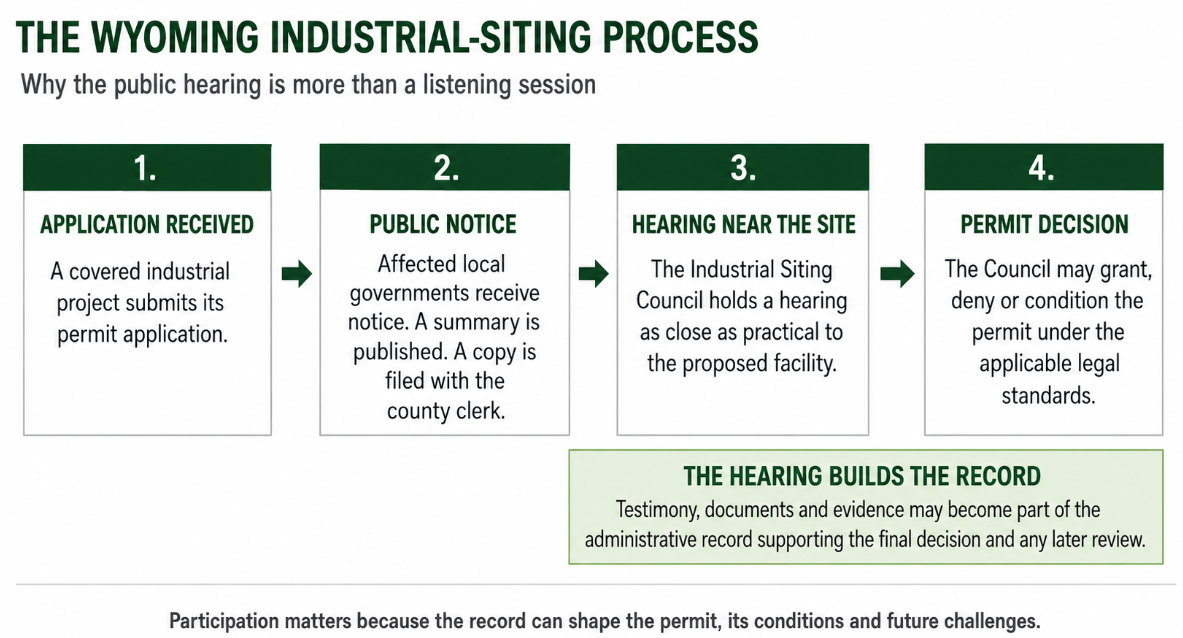
Wyoming’s standards give citizens a practical framework for investigation:
Does the facility comply with every applicable law?
Could it seriously injure environmental, social or economic conditions?
Could it substantially impair public health, safety or welfare?
Who pays for roads, emergency services, housing pressure and other local impacts?
Does the applicant have sufficient resources to decommission and reclaim the property?
Are financial assurances enforceable if the company sells, restructures or abandons the facility?
The council may impose conditions, including financial protections. An aggrieved party may seek judicial review, but Wyoming’s summary of the law identifies a short 30-day deadline after the final decision. Participation and deadlines therefore matter enormously.
Read more about the industrial siting here: Wyoming Legislative Service Office industrial-siting memorandum
The NRC Door Is Narrower, but It Is Real
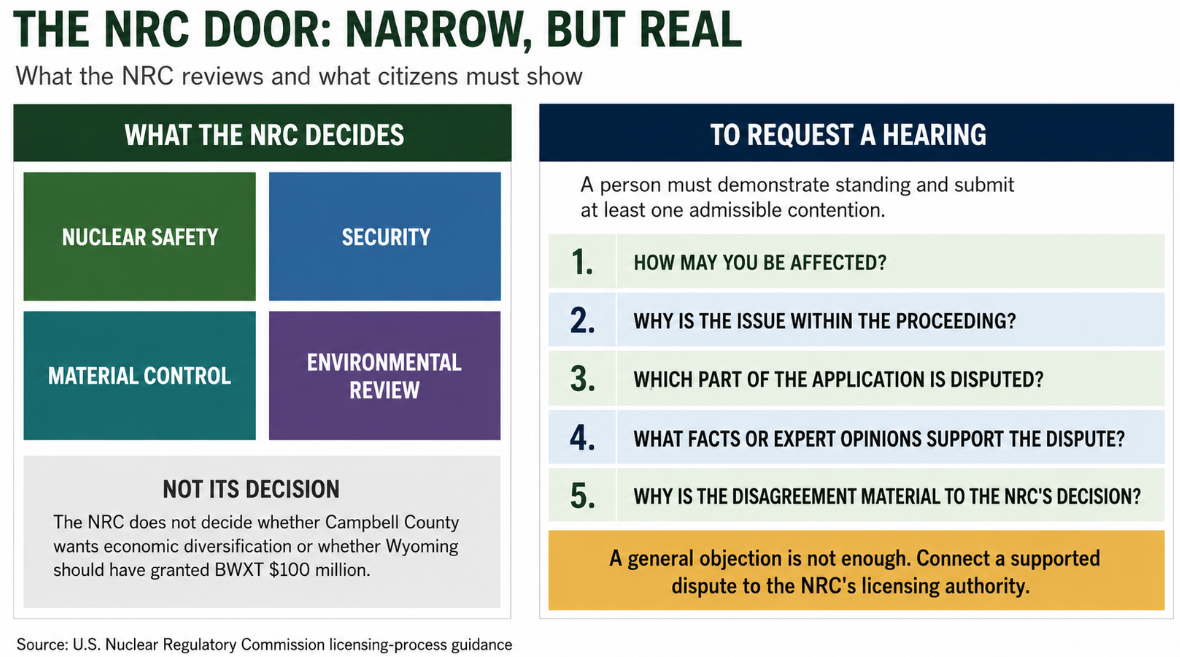
The NRC does not decide whether Campbell County wants economic diversification or whether Wyoming should have granted BWXT $100 million. Its jurisdiction centers on nuclear safety, security, material control and environmental review.
AI generated interpretation
For major fuel-cycle licensing actions, the NRC publishes notice of an opportunity to request a hearing. A person seeking formal intervention must demonstrate standing and submit at least one admissible contention.
Read more about this process here: NRC licensing-process guidance.
That means explaining:
How the person may be affected
Why the issue falls within the proceeding
Which part of the application is disputed
What facts or expert opinions support the dispute
Why the identified disagreement is material to the NRC’s decision
A petition saying only that nuclear material is frightening will probably fail. A supported contention identifying a material omission, faulty analysis or unresolved safety conflict may receive consideration.
Anyone seriously contemplating NRC intervention should obtain legal and technical assistance early. This is specialized administrative litigation, and missed filing deadlines can end the effort before the evidence is heard.
Closed Doors Do Not Eliminate Public Accountability
Final governmental action must occur publicly. Records held by the government are generally presumed open unless a specific exemption applies. Wyoming law ordinarily requires readily available records to be released immediately and other responsive records within 30 calendar days unless good cause prevents release. Requesters may use the state public-records ombudsman or petition district court in a dispute.
Read more about this kind of petition here: Wyoming Public Records Act.
Citizens should request narrowly defined records such as:
Signed letters and memoranda of understanding
Meeting calendars and agendas
Communications between officials, BWXT and development organizations
Funding applications and award conditions
Infrastructure and utility commitments
Emergency-response and fire-protection assessments
Site-selection documents
Tax, land and workforce agreements
Records showing recusals, votes and conflicts of interest
An NDA signed by a government official is not automatically stronger than Wyoming’s public-records and open-meetings laws. Whether a particular record is exempt depends on the law and the document, not merely on the word “confidential” stamped across it.
Can Wyoming Citizens Actually Stop the Project?
Yes, but not through outrage alone.
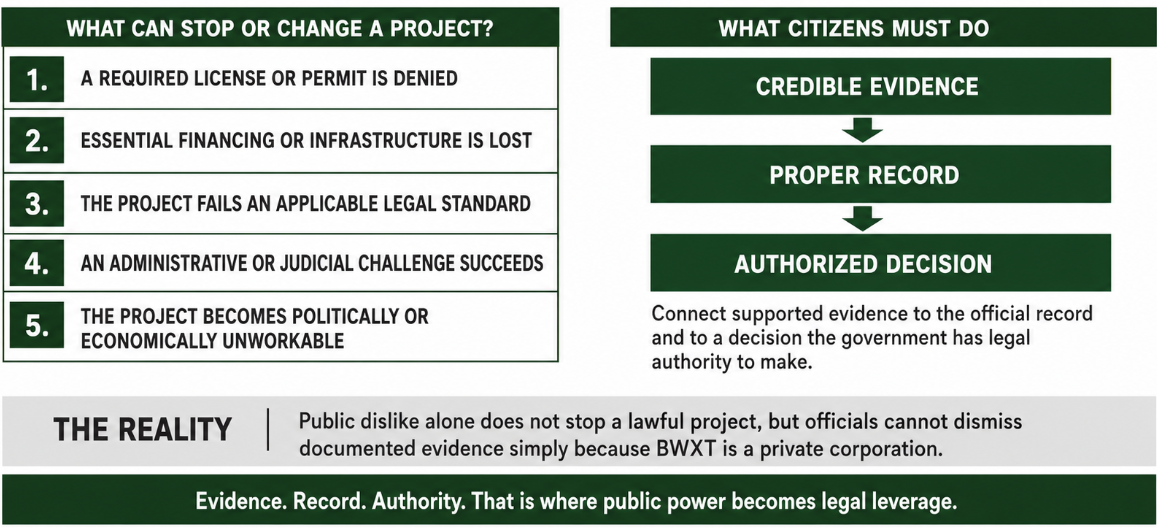
A project can be delayed, altered or stopped if it cannot obtain a necessary license or permit, loses essential financing or infrastructure, fails a legal standard, encounters a successful administrative or judicial challenge, or becomes politically and economically unworkable.
If the affected citizens can produce credible evidence, place it into the proper record and connect it to a decision the government has authority to make.
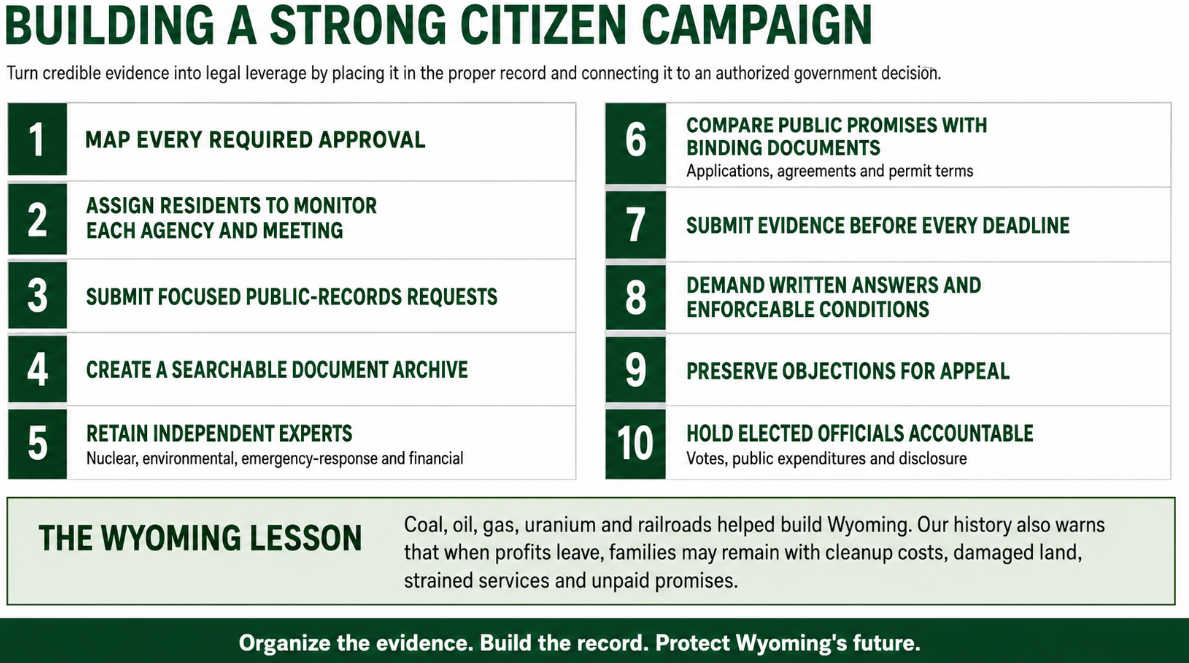
The question is no longer simply whether BWXT can satisfy the minimum requirements for a federal license. The larger question is whether Wyoming citizens will be allowed to shape their state’s nuclear future before that future has already been decided for them.
Sources
Wyoming Energy Authority. “BWXT TRISO Fuel Fabrication Facility in Wyoming: Campbell County Large Project Energy Matching Fund.” December 2025. https://wyoenergy.org/wp-content/uploads/2025/12/BWXT-One-Pager-with-Comments.pdf
U.S. Nuclear Regulatory Commission. “Fuel Cycle Facilities.” Updated March 11, 2026. https://www.nrc.gov/materials/fuel-cycle-fac
U.S. Nuclear Regulatory Commission. “NRC Technical Presentation.” ADAMS Accession No. ML24131A078. 2024. https://www.nrc.gov/docs/ML24131A078.pdf
Fuller, Brian. “Topic Summary: Industrial Siting.” Memorandum to the Wyoming Joint Minerals, Business and Economic Development Interim Committee. Wyoming Legislative Service Office, April 8, 2022. https://wyoleg.gov/InterimCommittee/2022/09-202204258-05TopicSummary-IndustrialSiting.pdf
Kidd, Sam C. “From TerraPower to the Trona Patch: Wyoming, Future Home of the Country’s First Commercial Advanced Reactors.” Oil, Gas and Energy Resources Law Section Report 49, no. 1, Winter 2025, pp. 34–40. https://www.uwyo.edu/ser/_files/docs/research/publications/joule-consolidatedwaste-paper.pdf
U.S. Nuclear Regulatory Commission. “Adjudications and Hearings.” Updated May 19, 2026. https://www.nrc.gov/about-nrc/regulatory/adjudicatory
Wyoming Department of Administration and Information. “Public Records.” Accessed July 31, 2026. https://ai.wyo.gov/about-us/transparency/public-records
Wyoming Legislature. “Wyoming Public Records Act.” Wyoming Statutes, Title 16, Chapter 4, Article 2, §§ 16-4-201 through 16-4-205. Current through 2026. https://wyoleg.gov/statutes/compress/title16.pdf
 Boomtown or Meltdown
Leave a comment