
Technical specifications and cogeneration capabilities in Wyoming industrial sectors.
At a Glance:
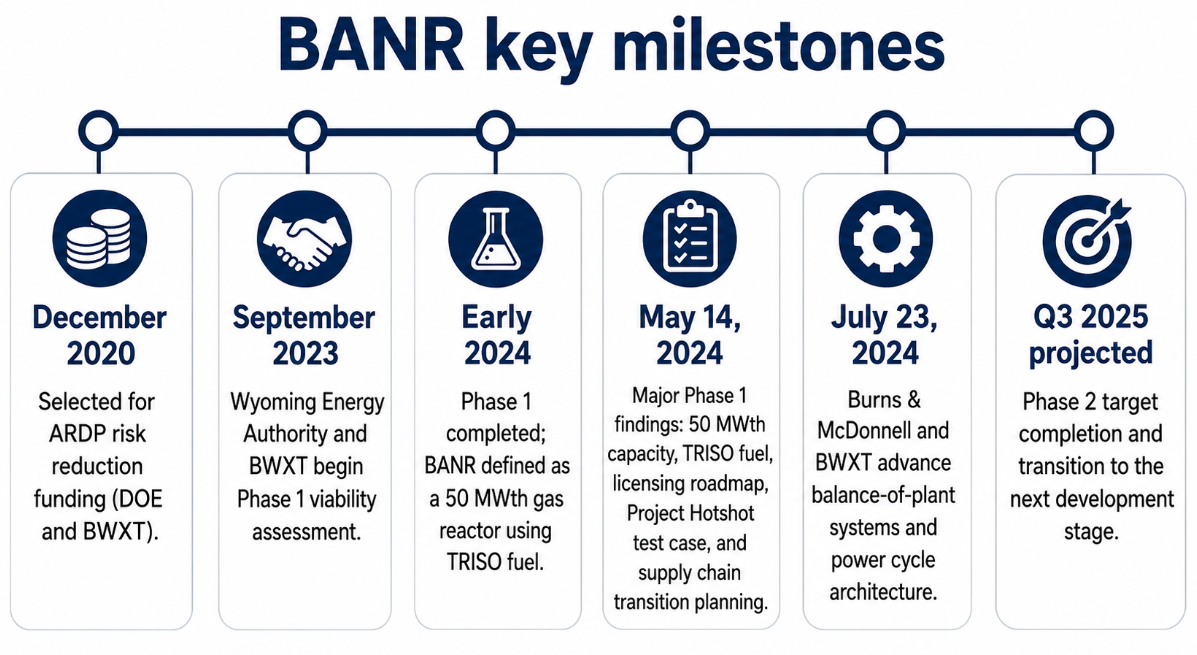
Up to 8 BANR microreactors have been proposed for a Wyoming soda-ash facility.
BANR is designed to provide both industrial heat and electricity, not conventional public-utility power alone.
Project Hotshot is a regulatory test case addressing roughly 33 unresolved microreactor issues.
BWXT’s model includes manufacturing, module transportation, operation, storage, refurbishment, disposal, and long-term spent-fuel management.
State, county, and city decisions can help advance deployment through funding, permitting, zoning, infrastructure, utilities, and public endorsements.
The current push for microreactors in Wyoming is not an organic evolution of the power grid, but a calculated, multi-year industrial maneuver designed to bypass traditional energy infrastructure.
BWXT’s May 14, 2024 presentation to the U.S. Nuclear Regulatory Commission regarding regulatory and licensing considerations for the BWXT Advanced Nuclear Reactor commercial program.
This transition represents an unprecedented and largely untested shift toward placing nuclear assets directly into the hands of private industrial operators. For community organizers and the general public, understanding the precise timeline and the entities driving this expansion is the first requirement for meaningful oversight.
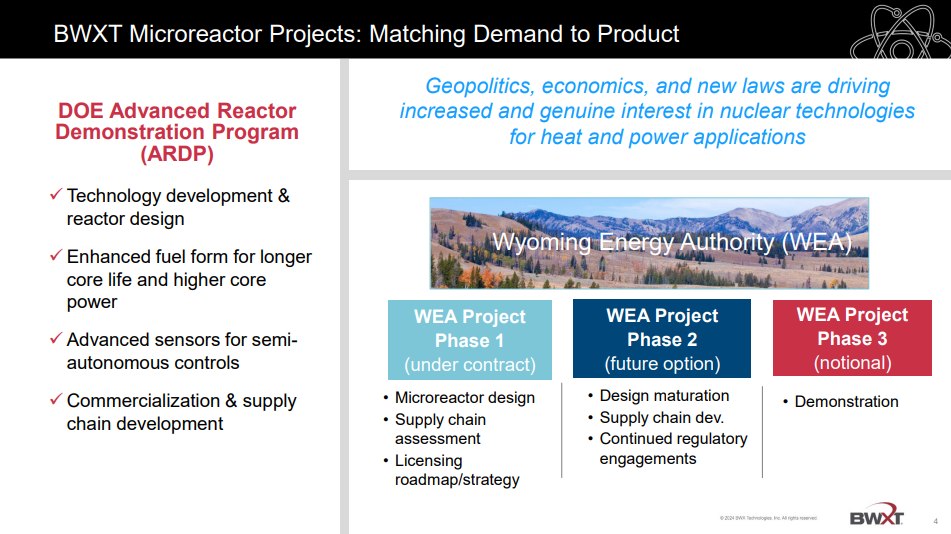
Source: BWXT, Microreactor Regulatory Considerations, May 14, 2024. The presentation specifically identifies the Wyoming Energy Authority project and its planned Phase 1–3 development path. NRC ADAMS No. ML24131A078, p. 4.
This report attempts to strip away some of the corporate jargon to map BWXT’s activities, providing a clear-eyed assessment of why all in Wyoming must recognize the risks of this industrial encroachment. What is being sold as “innovation” is, in fact, a fundamental restructuring of state energy policy to possibly benefit a single corporate entity: BWX Technologies, Inc. (BWXT).
BWXT’s Advanced Nuclear Reactor (BANR):
BWXT’s own deployment model shows that BANR is not simply a reactor placed at one site. It is a full commercial system extending from reactor design and licensing through manufacturing, fresh-module transport, regional siting, on-site operation, storage, used-module transport, refurbishment, disposal, and long-term spent-fuel management.
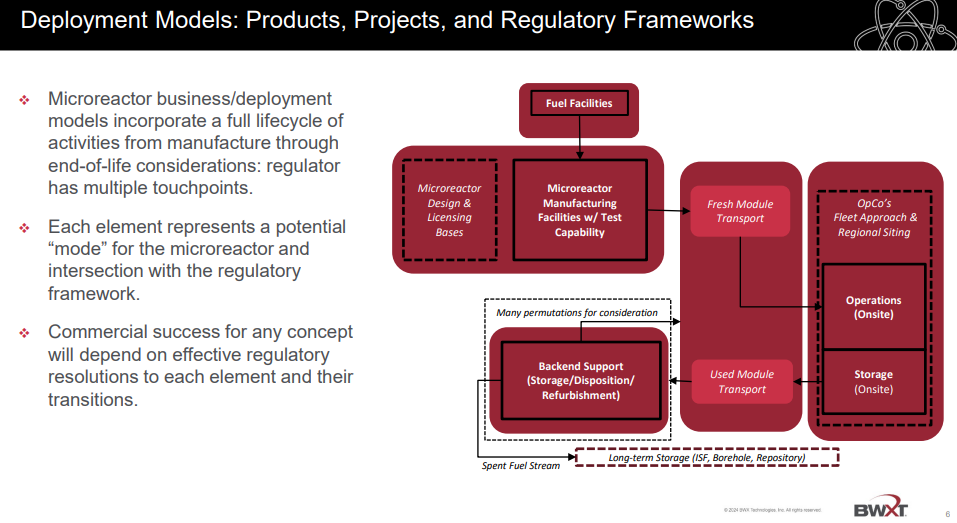
The slide maps the proposed lifecycle from manufacturing and fresh-module transport through on-site operation, storage, used-module transport, refurbishment, disposal, and long-term spent-fuel storage. NRC ADAMS Accession No. ML24131A078 pg 6.
BWXT explicitly states that regulators will encounter multiple “touchpoints” across this lifecycle and that every component may become its own regulated “mode.”
That framing matters because it reveals a project whose risks are distributed across factories, transportation corridors, industrial sites, storage facilities, and waste pathways rather than contained within one conventional nuclear plant.
Project Hotshot
Project Hotshot was presented by BWXT as a practical test case for resolving regulatory questions that affect commercial microreactor deployment. The company explained that roughly 33 regulatory topics identified by the Nuclear Energy Institute (NEI) intersect with the proposed microreactor business model.
These include demonstrating the reactor’s safety case, determining how an operating company could manage multiple reactors as a fleet, completing site characterization and environmental reviews efficiently, and addressing issues that are unique to small transportable reactors.
The slide also shows that the project was intended to do more than support one reactor. BWXT expected the regulatory decisions developed through Project Hotshot to guide future discussions with other operating companies and future project sites. In other words, the project could help establish a more repeatable process for licensing similar reactors elsewhere, while still requiring project-specific review.
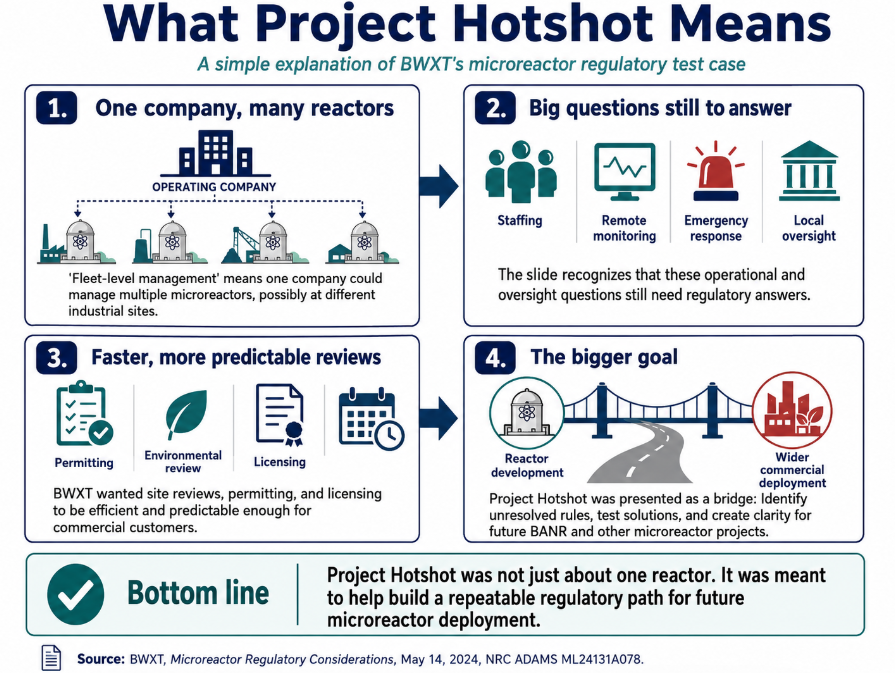
A key phrase is “fleet-level management of many microreactors.” This suggests a commercial model in which one company could oversee multiple units, potentially across several industrial locations. The slide does not explain exactly how staffing, remote monitoring, emergency response, or local oversight would work. It does show that these questions were recognized as part of the regulatory work that still needed to be resolved.
The reference to meeting “market constraints” means BWXT was also concerned with whether site reviews, environmental permitting, and licensing could be completed fast enough for commercial customers. That does not necessarily mean safety requirements would be removed, but it does mean regulators were being asked to consider how the process could become more efficient and predictable.
Project Hotshot appears to have been designed as a bridge between reactor development and wider commercial deployment. Its purpose was to identify unresolved rules, test possible solutions, and create regulatory clarity that could later be used for additional BANR projects and other microreactor developments.
Beyond the Reactor: Transport, Waste, and Wyoming’s Full Lifecycle Responsibility
The transportable model creates recurring public-safety and accountability concerns. Fresh reactor modules would be moved from manufacturing facilities to operating sites, while used modules could later be transported away for storage, disposal, or refurbishment.
This means communities may be exposed not only to the operating reactor but also to repeated movement of nuclear equipment and radioactive material through public infrastructure. The diagram also leaves several possible back-end arrangements open, including on-site storage, off-site storage, refurbishment, interim storage, borehole disposal, or repository disposal.
BWXT describes these as “many permutations for consideration,” which underscores that the final waste and decommissioning responsibilities are not inherent in the reactor product itself and may remain unresolved when deployment begins.
This model is therefore less a self-contained energy installation than a vertically integrated nuclear supply chain built around BWXT’s manufacturing, licensing, transport, service, and fuel-management capabilities.
Commercial success, according to BWXT, depends on regulators resolving each component and the transitions between them. For Wyoming, the central question is not merely whether BANR can provide industrial heat and power. It is whether the state is prepared to host and regulate an entire reactor lifecycle, including manufacturing interfaces, module transportation, regional siting, on-site storage, used-fuel movement, refurbishment, disposal, and long-term waste obligations.
The most interesting thing was, Radiant’s journey through Wyoming’s legality zones showed Wyoming was nowhere near ready.
The “Guinea Pig” Scenario
Wyoming is being positioned as both the commercial demonstration site and the regulatory proving ground for BWXT’s BANR model. Burns & McDonnell described the project’s cogeneration concept as the first U.S. nuclear application intended to produce both electricity and industrial steam.
BWXT later entered discussions involving the possible deployment of up to eight BANR units at a Wyoming soda-ash facility, showing that the proposal is not necessarily limited to one experimental reactor.
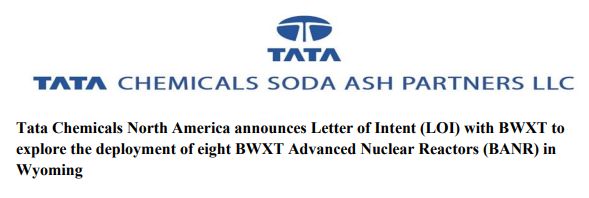
Source: Tata Chemicals North America, Dec. 12, 2024. The LOI explores deploying eight BANR microreactors in Wyoming.
At the same time, BWXT’s own NRC presentation describes Project Hotshot as a “test case” for resolving microreactor regulatory topics using a prospective operating company, the BANR technology, and an actual commercial business case.
The presentation identifies issues such as proving the safety case, managing fleets of many microreactors, accelerating site characterization and environmental permitting, and resolving regulatory questions that could later be applied to other projects.
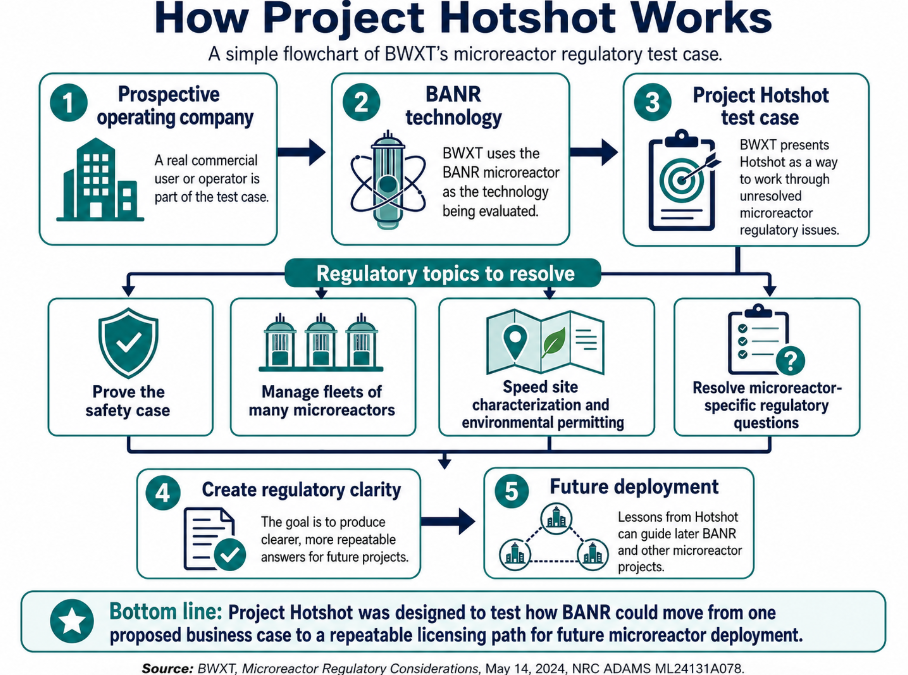
That is the real significance: Wyoming is not merely evaluating whether one reactor can provide heat and power. The project may help establish the licensing, operating, transportation, and site-review model used for later fleets.
Streamlining does not automatically mean eliminating safety rules, but it could reduce how often major questions are reconsidered from scratch at each new location. Wyoming residents are therefore being asked to accept the first commercial risks while decisions made here may become the template for deployment elsewhere.
Architecture of Expansion: Corporate and State Partners
Wyoming’s nuclear expansion is not being driven by BWXT alone. It depends on a layered network of corporate, state, county, and municipal partners. BWXT controls the reactor technology and fuel supply.

Screenshot of WEA logo from website
The Wyoming Energy Authority helps connect the project to state funding, industrial users, regulatory planning, and economic-development channels. Burns & McDonnell provides the engineering work needed to move the project from concept toward plant design, infrastructure planning, and eventual site integration.
The state government can accelerate this process through grants, tax incentives, permitting coordination, workforce programs, infrastructure funding, and agreements with industrial partners. County commissions may influence zoning, land-use approvals, road access, emergency planning, public-health coordination, and local economic-development support.
Mayors and city councils can help through utility agreements, annexation decisions, water and sewer access, public-safety planning, housing development, and public endorsements that give the project political legitimacy.
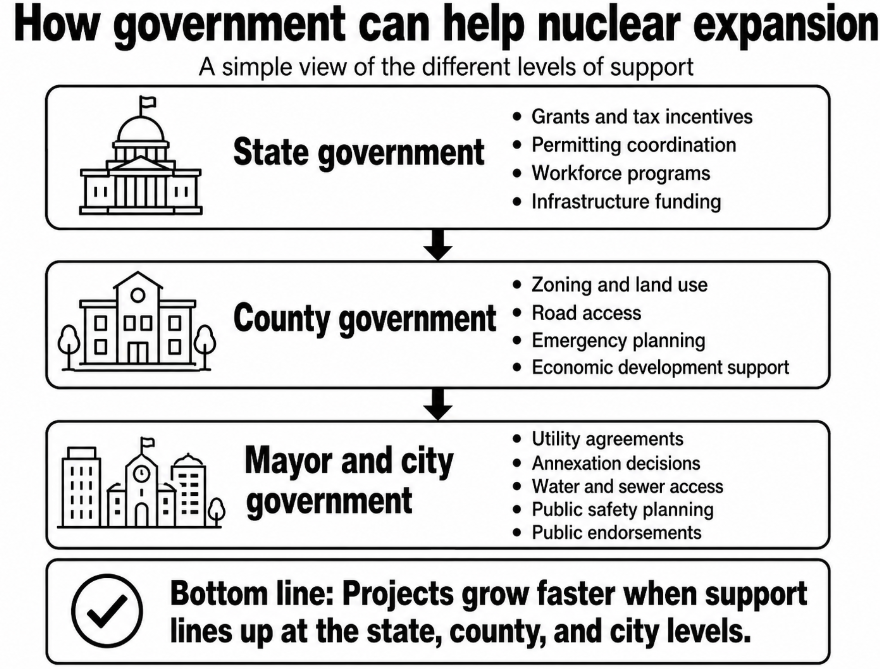
These local decisions may appear routine when considered separately, but together they can create the practical foundation a reactor project needs. A supportive letter, infrastructure commitment, training partnership, emergency-services agreement, or land-use decision can move the project forward before the public fully understands the long-term implications.
That is why transparency must begin at the earliest stages, not after major agreements have already been signed.
This is only the visible portion of the expansion architecture. Much more remains to be examined, including funding relationships, local commitments, tax arrangements, permitting strategies, transportation routes, emergency-response costs, waste responsibilities, and decommissioning obligations.
The public must understand not only what BWXT proposes, but also how state and local officials may be helping turn that proposal into a permanent industrial system.
 Boomtown or Meltdown
Leave a comment