
Why Wyoming Should Demand Distance, Accountability, and Transparency Before Accepting Nuclear in Our Backyard
Imagine a world where money was not the ruling force behind every decision, where industries seeking profit were still required to consider the people and land around them. In that world, companies like Radiant and other nuclear startups would not plant their operations on the doorsteps of towns.
They would not crowd up against neighborhoods, schools, and water supplies. Instead, they would build their facilities far outside city limits, far enough to eliminate daily anxiety over proximity and potential accidents.
Wyoming has the land. Wide open stretches of prairie and sagebrush could host these projects without swallowing entire communities. The towns could breathe, the industry could operate, and the public could rest easier. In such a compromise, nuclear would exist, but it would not loom.
The Challenge of Distance
Critics often point to the challenges of distance. A long commute, they say, would be impractical. But Wyoming is no stranger to distance. Coal miners already drive long stretches to reach the Powder River Basin. Oil and gas workers travel through rough terrain to reach remote fields. A dedicated shuttle system, company-sponsored buses, or carpooling could handle the workforce issue.
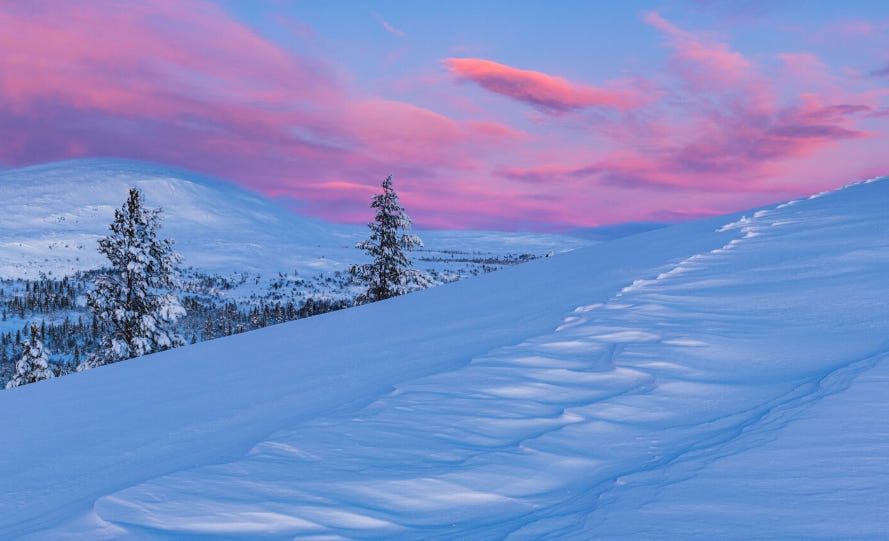
Image: Wyoming in the winter.
Yes, winters here in Wyoming are brutal.
Snowdrifts can trap a rancher for days, and roads can ice over in minutes. But those conditions are already faced by existing industries. Companies willing to commit to worker safety could design solutions, just as they do in Alaska’s oil fields or Canada’s mines. Harsh weather is not an excuse for poor planning, and it certainly should not be used to justify planting nuclear reactors in the middle of town.
The Waste Question
At the heart of public distrust, and a much bigger issue, is nuclear waste. Nuclear companies routinely propose storing spent fuel on-site, often described as “temporary.”
But history has taught us that “temporary” in the nuclear industry is a slippery term. Temporary often becomes permanent, and decades later communities are still stuck with waste that was never supposed to stay.
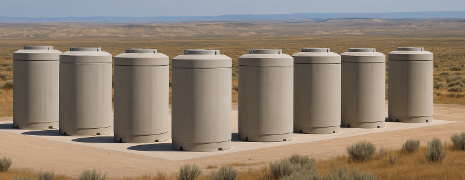
Image: what dry cask storage could look like.
If these companies want to produce nuclear power, they must not leave their waste behind.
That means not storing spent fuel on-site at the same facilities where reactors are built and operated, and it also means not quietly welcoming back nuclear waste from the very states to which they ship their reactors. Wyoming should not be turned into a dumping ground for the leftovers of other markets just because companies see open land and fewer people to resist.
Federal Responsibility, Not Local Burden
The responsibility for storage and management belongs at the federal level, not at the county courthouse. If Washington wants nuclear as part of the energy portfolio, then Washington must accept responsibility for the consequences, from secure transport to long-term storage. Local governments and taxpayers should not be forced to manage liabilities measured in thousands of years.
The Department of Energy already has mechanisms for oversight. The U.S. military manages far more dangerous stockpiles with strict protocols. If nuclear waste cannot be stored responsibly at a national level, then it should not be produced in the first place. States like Wyoming should not be treated as the dumping ground of industry simply because we have open land and sparse populations.
Transparency or Nothing
Compromise is only possible if there is transparency. Communities cannot be asked to take a leap of faith while nuclear companies sign non-disclosure agreements and hold closed-door meetings with government officials. Trust is not built in secret. Trust is built when questions are answered clearly, when liabilities are spelled out, and when companies stand up in public forums and accept accountability.
If nuclear companies refuse to be transparent, if they continue to sidestep responsibility for waste, and if they insist on planting reactors directly in communities instead of responsibly locating them farther away, then Wyoming has no reason to host them at all.
A Path Forward
This does not have to be a dead end. Wyoming could, in theory, allow nuclear development under the right conditions:
Facilities placed far from population centers, with safe and practical transportation plans for workers.
Clear, enforceable federal responsibility for all waste storage and cleanup.
Public meetings where answers are given openly, not hidden behind legal agreements.
Without those conditions, nuclear has no place here. Wyoming’s legacy industries already show what happens when profits dry up and responsibility is passed along. The scars of coal mines remain, visible from space. Add radioactive waste to that legacy, and the damage would extend for thousands of years.
Conclusion: Halt Until Honesty Arrives
The nuclear industry wants a foothold in Wyoming, but the terms must be clear. Until companies like Radiant are willing to compromise, until they show honesty about waste, until they place the well-being of communities above their own bottom line, the answer should be simple. Halt the process. Stop the negotiations. Wyoming has no obligation to shoulder risks hidden behind polished presentations and promises of jobs.
 Boomtown or Meltdown
Leave a comment